
We are currently starving, and it has nothing to do with calories. In the span of a single century, our species has migrated from the open air into a ‘mal-illuminated’ built environment. We have traded the full-spectrum nutrition of the sun for the toxic spikes of artificial light. This is not a lifestyle change; it is an evolutionary mismatch of huge proportions that has left our cells (specifically our mitochondria), dysregulated and dim. While we hide behind glass, our bodies are missing a fundamental conversation with the light that forged them.
The ancient Greeks described the ‘rosy-fingered dawn’ (eos rhododaktylos) not as a mere weather event, but as a sacred physiological input. For millennia, we dismissed this as poetry. We were wrong. Western science is catching up to what the Vedas and the Desert Fathers intuited: light is not merely symbolic nutrition for the soul; it is literal food for the human cell. What our ancestors ritualized as prayer, we can now measure as the release of nitric oxide and the activation of subcellular melatonin. The poets were describing pharmacology.

The Indoor Species
The human genome was forged in the crucible of the natural environment, shaped by millions of years of exposure to the diurnal cycles of light and dark, the radiant heat of the sun, and the thermal fluctuations of the seasons. Our biological systems are not closed loops. They are open systems that depend on specific environmental inputs to regulate circadian rhythms, drive metabolic processes, and maintain neuroendocrine balance. In the span of a single century, we have migrated from an outdoor existence bathed in the full spectrum of solar radiation to a sedentary, indoor existence illuminated by artificial light sources that bear little resemblance to the light our bodies evolved in.
Researchers have begun calling it “mal-illumination,” a term that captures the strange new deficiency disease of our age. We live behind glass that filters out the beneficial wavelengths while admitting others. We work under artificial lights that pump out narrow spikes of blue light while almost completely lacking the balancing red and infrared wavelengths found in natural sources. We have created a light environment that is, from the perspective of our cells, impoverished to the point of toxicity.
The consequences are measurable. Studies on animals raised exclusively under modern LED lighting show mitochondrial dysfunction, fatty liver, elevated blood glucose, and reduced lifespan. The cells become less responsive. Energy production falters. The body’s ancient light-dependent systems, honed over evolutionary time to expect certain inputs, receive signals that confuse and dysregulate them. We have, without realizing it, broken something fundamental in the conversation between our bodies and the light that bathes them.
Two Paths to the Same River
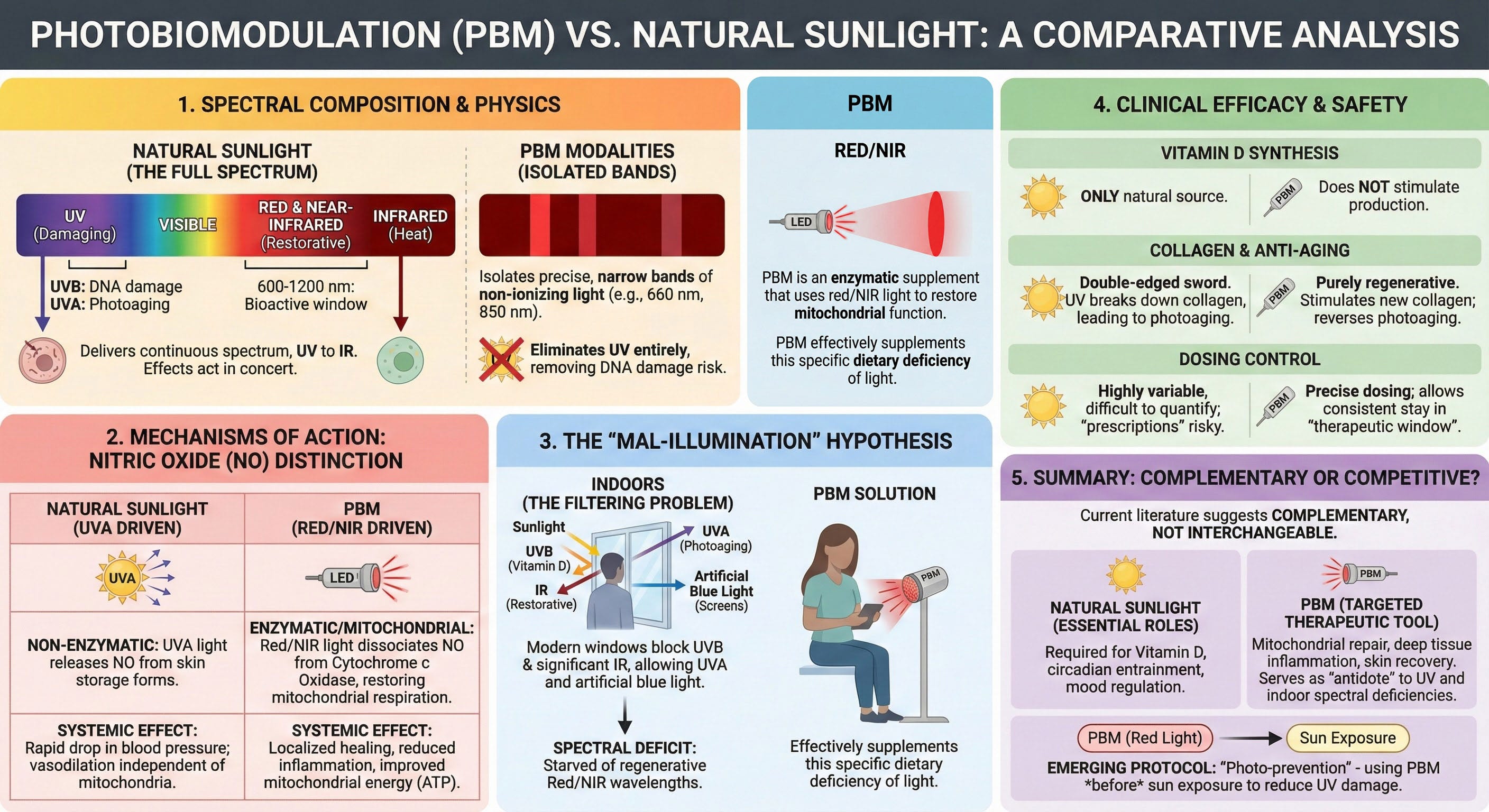
Into this deficit, two apparent solutions have emerged. The first is as old as life itself: natural sunlight, reframed not as something to fear and avoid but as a biological input essential for human thriving. The second is technological: photobiomodulation (PBM) devices, often called red light therapy, that emit specific wavelengths of red and near-infrared light to target cellular processes directly. A debate has emerged in wellness circles about which is “better,” which is more natural, which deserves our attention and investment.
This debate, I want to suggest, fundamentally misunderstands what both are doing. Sunlight and red light therapy are not competitors vying for the same biological niche. They are complementary interventions that operate through entirely different mechanisms, offering distinct and non-overlapping benefits. Understanding this distinction requires us to look at what happens when photons meet flesh.
Both sunlight and PBM increase systemic nitric oxide, a molecule essential for cardiovascular health that dilates blood vessels and improves circulation. But they do so through completely different pathways. When ultraviolet light from the sun strikes the skin, it triggers the release of nitric oxide from stores that have accumulated in the epidermis and dermis. The skin, it turns out, functions as a vast reservoir of nitrogen oxides, waiting to be mobilized by specific wavelengths of light. This UV-triggered release is immediate and potent, explaining why sun exposure correlates with lower blood pressure independent of vitamin D status.
PBM operates differently. Red and near-infrared light penetrate deep into tissue, passing through the epidermis and dermis to reach muscle, bone, and even brain tissue. There, specific wavelengths are absorbed by cytochrome c oxidase, the terminal enzyme in the mitochondrial electron transport chain. Under conditions of stress, inflammation, or aging, excessive nitric oxide binds to this enzyme, acting as a molecular clog that inhibits cellular respiration and ATP production. When photons in the therapeutic window strike this enzyme, they break the bond between the nitric oxide and the cytochrome, releasing the gas and restoring normal mitochondrial function. The effect is not merely to increase nitric oxide but to liberate it from where it has become pathologically stuck.
The Mitochondrial Battery
What the contemplatives intuited about light as a form of spiritual nourishment is now being revealed by contemporary cell biology to be physiologically precise. Mitochondria are not merely chemical engines; they are light-sensitive batteries that evolved from bacteria in ancient oceans, adapting over eons to the diurnal cycles of solar radiation. When we speak of the body’s energy production, we are speaking of processes that remain fundamentally light-dependent, even after billions of years of evolutionary development.
Recent research has uncovered mechanisms that would have seemed impossible a generation ago. Long-wavelength light, particularly in the red and near-infrared spectrum, appears to interact with the water surrounding mitochondrial membranes, changing its viscosity and allowing the ATP synthase motor to rotate more freely, producing more cellular energy with less friction. Light acts not only through chemical pathways but through the physics of cellular architecture itself.
The discovery of subcellular melatonin is game-changer. While we know melatonin as the sleep hormone produced by the pineal gland, ninety-five percent of the body’s melatonin is actually produced outside of the pineal gland, inside the mitochondria themselves. Its production there is triggered by exposure to near-infrared light. This subcellular melatonin does not make you drowsy; instead, it acts as a potent antioxidant precisely where it is most needed, neutralizing the reactive oxygen species generated during energy production. The ancient practices of greeting the dawn and exposing the body to morning light rich in near-infrared wavelengths were not merely spiritual rituals. They were techniques for activating the body’s own antioxidant production at the subcellular level.

What the Sun Gives That Technology Cannot
Natural sunlight delivers something that no PBM device can replicate: the whole orchestra. When morning light strikes the body, it brings ultraviolet, visible, and infrared wavelengths in proportions that shift predictably throughout the day. The infrared arrives first, present in abundance at dawn, preconditioning the skin and boosting protective antioxidants before the more intense ultraviolet radiation of midday. This temporal relationship is not accidental; it is a feature of solar physics that our bodies evolved to expect and depend upon.
Sunlight remains the only natural source of vitamin D synthesis, a process that PBM cannot trigger. When UVB radiation strikes the skin, it converts 7-dehydrocholesterol into the precursor that becomes the vitamin, or more accurately, the hormone that regulates hundreds of genes throughout the body. Red light devices, operating entirely outside the ultraviolet spectrum, offer no such benefit. For those seeking to optimize vitamin D status, sunlight remains irreplaceable.
Perhaps most importantly, sunlight serves as the primary zeitgeber, the time-giver, for the human circadian system. Specialized cells in the retina containing the photopigment melanopsin are highly sensitive to the blue spectrum of morning light. These cells are not involved in vision; they exist solely to communicate the time of day to the suprachiasmatic nucleus in the brain, which then orchestrates the hormonal rhythms that govern wakefulness, metabolism, and sleep. Morning sunlight exposure, particularly within the first hour of waking, anchors the circadian system and sets a biological timer for melatonin release approximately twelve to fourteen hours later. This cannot be replaced by any device.
What Technology Gives That Sunlight Cannot
If sunlight is the full orchestra, PBM is a precision instrument. It eliminates ultraviolet entirely, removing the risk of DNA damage and allowing for higher doses of regenerative wavelengths to be applied safely. For skin health specifically, this distinction really matters. Sunlight is a double-edged sword for collagen. While it stimulates some beneficial adaptations, its UV component activates enzymes that break down the extracellular matrix, leading over time to the wrinkles and sagging we call photoaging. Red light therapy stimulates fibroblast proliferation and collagen production without any of these destructive components. It is often used specifically to reverse the damage that decades of sun exposure have caused.
PBM also allows for precise dosing, something impossible with sunlight. The therapeutic window for light therapy follows what researchers call the biphasic dose response: too little light does nothing, too much light inhibits healing, and somewhere in between lies the optimal zone. Because sunlight varies continuously with latitude, season, time of day, and cloud cover, it is nearly impossible to quantify the exact dose the body receives on any given day. Red light devices deliver measurable irradiance over specified time periods, allowing practitioners to stay consistently within the therapeutic range.
The penetration capability of near-infrared light opens applications that sunlight simply cannot reach. Unlike UV, which is absorbed almost entirely in the superficial skin layers, near-infrared wavelengths pass through clothing, through skin, and even through the skull to reach the cerebral cortex. Transcranial PBM has shown remarkable promise for cognitive enhancement, neuroprotection, and recovery from brain injury. Studies have demonstrated improvements in working memory, reductions in neuroinflammation, and significant recovery from the cognitive fog that those with long Covid experience. The retina, which has the highest concentration of mitochondria of any tissue in the body and ages faster than most organs, has shown improvements in color contrast sensitivity following brief exposures to deep red light. These are adjuncts for sunlight which offers no comparable intervention.
The Community of Light
One of the most striking findings in PBM research challenges our assumption that light therapy must be local to be effective. Mitochondria, it turns out, act as a community. Irradiating one part of the body can trigger systemic signaling that benefits distant tissues. Studies have shown that shining red light on the back can improve blood glucose regulation throughout the body, reducing glucose spikes after meals by more than twenty percent. In animal models of pneumonia, irradiating the blood or even the skin reduced inflammation in the lungs. This “bystander effect” suggests that PBM is not merely a local therapy but a systemic modulator of cellular function.

The mechanism likely involves the alteration of circulating immune cells. When light strikes the dense capillary network within the dermis, it irradiates the blood passing through, changing the phenotype of leukocytes and macrophages and increasing the systemic circulation of anti-inflammatory cytokines. What enters the skin as local light emerges as a body-wide conversation in the language our cells were designed to speak.
The Mortality Paradox
Perhaps the most challenging data for our current cultural assumptions about light comes from epidemiological studies that tracked sun exposure habits over decades. A landmark Swedish study following nearly thirty thousand women for twenty years found that those who avoided sun exposure had double the mortality rate of those with the highest sun exposure habits. The risk of avoiding sunlight was comparable in magnitude to the risk of smoking. In fact, smokers who sought the sun had a similar life expectancy to non-smokers who avoided it.
This finding asks us to reconsider the blanket recommendations for sun avoidance that have dominated public health messaging for decades. Yes, sun exposure increased skin cancer incidence, but these were primarily non-melanoma cancers with low mortality. Conversely, sun avoidance drastically increased the risk of cardiovascular disease and type 2 diabetes, conditions that kill far more people than skin cancer ever has. The net effect of sun exposure, when all causes of death were considered, was a significant extension of life expectancy.
What mechanisms beyond vitamin D might explain this? The nitric oxide released from skin stores under UV exposure provides immediate cardiovascular protection. Beta-endorphins produced by keratinocytes under UV stimulation improve mood and pain tolerance. The full-spectrum infrared component of sunlight may activate protective pathways through the mechanisms PBM research has illuminated. The sun, it seems, is doing more for us than we have given it credit for, and the price of avoiding it entirely may be higher than the price of thoughtful, moderate exposure.
Complementary, Not Competitive
The current literature is clear: these modalities are complementary, not interchangeable. Sunlight is required for vitamin D synthesis, for circadian entrainment, for mood regulation, and for triggering UV-dependent pathways that PBM cannot activate. PBM acts as a targeted therapeutic tool for mitochondrial repair, deep tissue inflammation, neurological conditions, and skin recovery, often serving as an “antidote” to the damage caused by UV radiation and the spectral deficiencies of modern indoor life.
An emerging protocol suggests using red light therapy before sun exposure. The red wavelengths appear to precondition the skin, up-regulating antioxidant defenses and potentially reducing the damage caused by subsequent UV exposure. This photo-prevention approach exemplifies how these modalities can work synergistically, each enhancing the benefits and mitigating the risks of the other.
For the practical integration of both, the research points toward a protocol: morning sunlight exposure within the first hour of waking, ideally for ten to thirty minutes, to anchor circadian rhythms and begin the daily conversation between body and light. Targeted PBM sessions can follow, particularly in the evening when avoiding blue light matters most, or after exercise when the tissues are primed for recovery. The key is understanding that each offers something the other cannot, and that the body, evolved over millions of years in the presence of full-spectrum solar radiation, benefits from both.

The Return
We began with the rosy-fingered dawn of Homer and the sunrise salutations of the Vedas. We have traveled through cytochrome c oxidase and mitochondrial melatonin, through epidemiological cohorts and controlled trials. And we arrive, as we so often do in this work, at the same conclusion the ancients reached through different means: the body knows what it needs, and we have removed much of what it needs from our lives.
The modern prevalence of chronic disease is, in part, a symptom of our estrangement from the natural environment. We have removed the photo-biological inputs that our bodies evolved to expect and require. Light and heat are not optional therapeutic extras; they are fundamental biological requirements. What the contemplatives discovered through direct experience, contemporary neuroscience and cell biology are now validating through measurement.
The debate between sunlight and PBM resolves itself when we understand that neither alone can restore what has been lost. The sun remains our primary source of circadian entrainment, vitamin D, and the broad-spectrum inputs our cells expect. PBM offers precision interventions for conditions and tissues that natural light cannot reach, with doses that can be calibrated to stay within the optimal therapeutic window. Together, they represent not a return to a primitive past but a reclamation of biological wisdom using both ancient practices and modern tools.
The prescription of the future may well be written in wavelengths and degrees. And perhaps, in the early hours when the eastern sky begins to lighten, we will remember what our ancestors passed down to our bones. When we stand in the presence of the rising sun we experience the beauty of poetry and soak up medicine for our physiology. It is, in a very real sense, food for the light-hungry beings we have always been.