
The young man I was meeting with was thirty-four, an AI engineer with a sharp mind and a kind face. His wife had been doing everything right. Prenatal vitamins. Yoga. The cleaner-than-clean diet. They had been trying to conceive for six months. She had come to her own physician with a list of questions. He had come to me with one.
“Is there anything I should be doing?”

In the conventional model, the answer is short. Take a multivitamin. Maybe lose a few pounds. Avoid the obvious vices. The father shows up at the obstetrician’s office months later, often as an afterthought, sometimes as a footnote on the intake form. The cultural script is clear. Pregnancy is a maternal project. The man’s biological role started and ended at fertilization.
That script is wrong. It is not slightly wrong. It is fundamentally, mechanistically, and now demonstrably wrong. And the cost of that error is being paid by children we are still meeting in pediatric clinics, in psychiatric offices, in metabolic specialty care, decades later.
The father is not a peripheral actor in conception. He is a co-author of the initial conditions from which a human being emerges.
Why Your Body Is Currently Recording Your Choices
For most of medical history, sperm were treated as a courier. A delivery vehicle. Half the genome arrives, gets unpacked, and the real work of building a child happens in the maternal environment. The man’s contribution was understood as a sequence of letters. Static. Finished. Indifferent to whether he had spent the past three months training for an Ironman or eating drive-through and drinking himself to sleep.
That model has now collapsed. What has replaced it is something the contemplatives have been describing for thousands of years in different languages. The body is listening. The body remembers. And the body writes what it remembers into the next generation.
The molecular machinery that makes this possible is now understood with a precision that would have been science fiction twenty years ago. The sperm cell delivers DNA, yes. But it also delivers a multilayered epigenome. Patterned methylation marks across the genome. Selectively retained histones carry activating and repressive instructions. And a rich cargo of small non-coding RNAs that act in the embryo before the embryonic genome itself has even switched on.
Each of these layers is environmentally responsive. Each is rewritten during the roughly ninety days that separate a sperm stem cell from an ejaculated gamete. And each carries information about your recent biological state directly into the first hours of your child’s life.
The Ninety Days You Cannot Take Back
Spermatogenesis is one of the most precisely timed programs in human biology. As Michael Griswold’s lab at Washington State has documented, the spermatogenic clock is species-specific and effectively unalterable. No drug, no supplement, no protocol speeds it up or slows it down. From the initial division of a stem cell to the release of a mature gamete takes approximately seventy-four days inside the testis. Another 10 to 14 days follow as the sperm transit the epididymis. Roughly ninety days, total.

This is the biological duration of the cycle, validated in cohort after cohort. A study of 11,050 Chinese sperm donors across more than 44,000 semen analyses identified a critical exposure window of seventy to ninety days before collection for ambient temperature effects on sperm count and morphology. A Korean cohort confirmed the same window. Danish registry data found that paternal medication use during the spermatogenic window, and only during that window, predicted offspring outcomes.
Ninety days is the timeframe in which the sperm a man will deliver at conception is being constructed, modified, and finalized.
Whatever a man eats, drinks, breathes, fears, and feels in the three months before conception is being woven into the molecular architecture his child will inherit.
The Two Windows You Need to Know About
Within the ninety days, there are two periods when the developing sperm is most exquisitely sensitive to your systemic state. They sit at opposite ends of the cycle, they respond to different exposures, and they require different interventions. The structure below maps both.
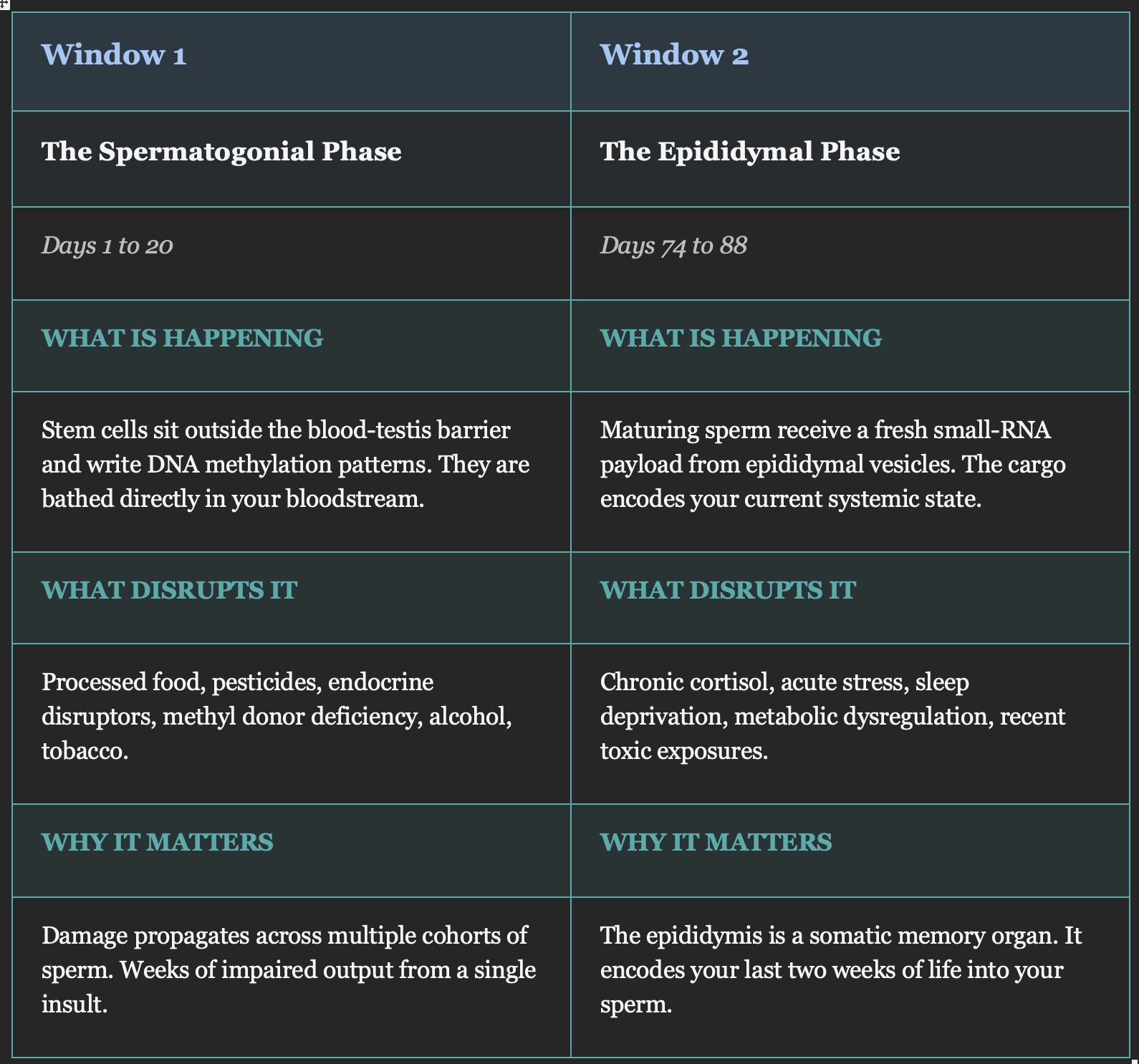
The epididymis is a somatic memory organ. It encodes your last two weeks of life into your sperm.
Tracy Bale’s group at Maryland demonstrated something that should change how every man thinks about stress and reproduction. The glucocorticoid receptors in the cells lining the epididymis respond directly to circulating cortisol. When the father is under chronic stress, those cells alter the microRNA cargo of the vesicles they secrete. The sperm passing through receive a stress-encoded payload. Offspring conceived twelve weeks after a paternal stress exposure showed measurable alterations in their HPA axis. Offspring conceived one week after the same stress did not. The epididymis was acting as a somatic memory organ. It retained the imprint of past systemic conditions and continued encoding that information into sperm for weeks afterward.
In Plain Terms
Your reproductive biology is closely monitoring your life. The first month of the cycle reflects what your bloodstream carries. The last two weeks record what your stress physiology is doing. The body of evidence we now have means that the cliché advice to the father, take a multivitamin and stop smoking, is grossly inadequate. The ninety days before conception are the most actionable windows in all of medicine.
What Your Sperm Carries Beyond DNA
The most surprising finding of the past decade is the role of small non-coding RNAs. These are short genetic transcripts, fragments of transfer RNA, microRNAs, that the sperm carries into the egg at fertilization. They do not encode proteins. They regulate gene expression in the early embryo, before the embryo has activated its own genetic machinery.
Qi Chen’s group showed that sperm transfer RNA fragments from fathers on a high-fat diet, microinjected into the zygotes of normally fed mice, caused glucose intolerance in the resulting offspring. The DNA was unchanged. The sperm RNA payload alone was sufficient to transmit the metabolic phenotype. In 2024, a Nature paper from the Teperino group extended this to humans. In two independent cohorts totaling more than three thousand families, paternal BMI independently doubled the risk of offspring obesity, and the molecular mediator was mitochondrial transfer RNA fragments in sperm.
Bale’s group performed the experiment that should be taught in every medical school. Stressed male mice transmitted blunted stress responses to their offspring. The investigators isolated nine specific microRNAs that were elevated in the sperm of stressed males. They microinjected those nine microRNAs into the zygotes of unstressed mice. The offspring developed the same blunted stress response. Nine RNAs in the sperm were sufficient to reprogram the entire HPA axis of the next generation.

What the Mystics Already Knew
There is a passage in the Sushruta Samhita, the Ayurvedic surgical text composed somewhere between 800 and 600 BCE, that reads as if its author had been waiting two and a half millennia for Tracy Bale’s experiments. The text instructs that a man preparing to conceive should attend to his diet, his sleep, his thoughts, and his contemplative practice for a period before the union, because what he is in that time becomes what the child will be.
Traditional Chinese Medicine was even more specific. The concept of jing, the constitutional essence stored in the kidneys and transmitted to offspring, was not abstract metaphysics. It was a practical observation that the father’s lived state shapes the child’s foundation. Jing was depleted by overwork, by excess, by chronic stress, by sexual excess. It was preserved by rest, by clean food, by emotional equanimity, by stillness.
Indigenous traditions from the Hopi to the Maori included formal preconception preparations for fathers. Periods of dietary purification. Abstention from intoxicants. Specific spiritual disciplines. The anthropological literature catalogs these as ritual. Molecular biology now suggests they were operational.
The contemplatives observed the father’s body, mind, and discipline in the months before conception, which are written into his child’s foundation.
The systems-medicine reframe is not that ancient wisdom replaces modern science. It is that the two converge. The Sushruta Samhita is corroborated by zygote microinjection studies. The TCM concept of jing is corroborated by mitochondrial transfer RNA fragments. The traditions had the observation. We have the mechanism.
The Modern Antagonists
The cruelty of the current moment is that men preparing to become fathers are stepping into the most epigenetically hostile environment in human history. Microplastics now appear in 100 percent of tested human testicular tissue samples. PFAS, the so-called forever chemicals, are detectable in the blood of most Americans. Sperm concentration in Western populations has declined approximately 52 percent between 1973 and 2011. Endocrine disruptors are ubiquitous in food packaging, personal care products, drinking water, and indoor air.
Layered on top of the chemical burden is the metabolic and circadian one. Insulin resistance, scrotal fat deposition driving aromatase activity, sleep disrupted by artificial light, and chronic psychological stress that keeps the HPA axis in a state of low-grade activation suppress the HPG axis from above. Cannabis use, which causes 29 percent lower sperm concentration in regular users, has accelerated. Alcohol consumption around conception is increasingly normalized. The food environment punishes anyone who is not actively defending against it.
These exposures land on the spermatogonial stem cells outside the blood-testis barrier and on the epididymal epithelium during sperm transit. The sperm pool that the average modern man delivers at conception carries the molecular signature of all of it.
Before You Read the Protocol, Take Stock
In a moment, I am going to give you the operational framework we have refined over years of clinical work at the Apeiron Center. But the protocol will land harder if you do something first. Pause. Take an honest inventory of the past ninety days of your own life.
How many drinks did you have last week? The week before that?
How often, in the past three months, have you smoked cannabis or used an edible?
How many nights in the past month did you get less than seven hours of sleep?
On a scale of one to ten, where has your stress lived for most of the past quarter? What woke you up at three in the morning?
How many days in the past two weeks did you eat ultra-processed food, drink from a plastic bottle, or apply a personal care product whose ingredients you have never read?
When was the last time you had a comprehensive lab panel? Do you know your testosterone, your insulin, your inflammatory markers, your DNA fragmentation index?
Most men, when asked these questions honestly, find the answers uncomfortable. That discomfort is the point. Molecular biology is not abstract. It is responding to the answers you just gave. The cells that will become the sperm you deliver at conception have been bathed in the conditions you have just inventoried.
Now read the protocol with that knowledge in front of you.
What the Ninety Days Can Do
Here is the redeeming biology. Most of these epigenetic perturbations are reversible within one full spermatogenic cycle. The studies are unambiguous. Cannabis-associated methylation changes at the DLGAP2 gene, a postsynaptic scaffold implicated in autism and schizophrenia, largely resolve after roughly seventy-seven days of abstinence. Nicotine-induced changes to global sperm methylation reverse with cessation. Paternal opioid use produces specific small-RNA signatures in sperm that disappear after ninety days of abstinence, and the offspring phenotypes those signatures transmit dissipate accordingly. Alcohol-induced microRNA changes are at least partially reversible.
Exercise is the one clearly positive paternal exposure with causal evidence. A 2025 study published in a Nature-level journal established that the offspring of exercise-trained fathers inherit improved endurance and metabolic parameters. The mechanism is sperm microRNA-mediated suppression of NCoR1, a transcriptional repressor of mitochondrial biogenesis, in the early embryo. The training fathers were not transmitting genes. They were transmitting an instruction set that reprogrammed the embryo’s mitochondrial machinery toward oxidative metabolism. No supplement replicates this.
In the Preconception Planning Program at Apeiron, we have spent years now applying this evidence with couples. The structure below is the simplified version we hand a man on day one. Each step is independently supported by clinical evidence. Together, they constitute the operational version of the molecular biology you just read.
Start Here. Your First Ninety Days.
The eight steps below are the framework. They are sequenced for impact. The earlier ones unlock the later ones.
1. Get baseline data.
Comprehensive paternal screening, including a DNA fragmentation index, full hormonal panel, metabolic markers, heavy metal and PFAS testing where indicated, methylation cofactor status, and a full exposome assessment. We also offer genetic testing, so couples can identify lifestyle interventions that may support their child’s genetic propensities.
2. Cut the inputs that are degrading your sperm.
Full abstinence from alcohol, cannabis, and nicotine for the entire ninety days. This is not negotiable. The reversibility data are clear, and the timeframe maps directly onto the spermatogenic cycle.
3. Eat the dietary pattern that supports methylation.
An ideal whole-food dietary pattern enriched with methyl donors. Leafy greens, eggs, organic liver if you can tolerate it, oily fish, cruciferous vegetables, and berries. Eliminate ultra-processed food, seed oils, and added sugar.
4. Move at moderate intensity.
Three to five sessions per week of moderate-intensity aerobic work plus two or three resistance training sessions. Avoid prolonged cycling and avoid overtraining. The goal is mitochondrial signaling, not destruction.
5. Sleep seven to seven and a half hours, consistently.
Same wake time every day. Cool, dark room. No screens after ten. Testosterone is synthesized during deep sleep. Your circadian phase is one of the most undervalued reproductive levers.
6. Aggressively reduce endocrine disruptor exposure.
Filter your water. Glass and stainless steel for food storage. Read every personal care product label. Eat organic where the evidence justifies it. Replace your plastic cookware. This is the layer most men ignore and most consistently regret ignoring.
7. Supplement the targeted basics.
CoQ10, L-carnitine, NAC, omega-3 with DHA emphasis, methylfolate, methylcobalamin, and selenium-zinc. Doses calibrated to your baseline labs and any genetic findings.
8. Build a stress-down practice.
Daily breathwork, meditation, time in nature, or HRV training. The epididymal window is responsive to your cortisol. This is not a soft-skills addition. It is a direct biochemical intervention.
We retest at ninety days. The DNA fragmentation index responds first, sometimes dramatically. Hormonal patterns recalibrate. Inflammatory markers fall. The men describe a quality of clarity and embodiment they had not experienced in years. Conceptions, when they occur, occur in a different physiological field than the one the couple started in.
The Conversation No One Is Having
The young man across from me listened to all of this. His face moved through the predictable sequence. Surprise. Skepticism. The slow recognition that something he had been told was a footnote was a chapter. And then the question I have heard now from dozens of men in his position.
“Why did no one tell me this before?”
The answer is partly historical. Preconception medicine was built around women because pregnancy was understood as something that happened in women’s bodies. The Developmental Origins of Health and Disease framework, born from David Barker’s work on fetal nutrition, was initially a maternal framework. The cultural script reinforced the clinical script, and the clinical script reinforced the cultural one. Along with a cultural meme that fathers only donate part of their DNA.
The deeper answer is that we, collectively, have not yet absorbed what molecular biology is telling us. The data are recent. The field is young. The clinical infrastructure has not been built. There is no equivalent of the obstetric prenatal visit for the father. There is no insurance code, in most systems, for the work.
This is the situation the contemplative traditions would recognize as a failure of attention. The information is available. The body is speaking. The mechanism is clear. We are simply not listening yet.
The body of the father is not a peripheral consideration. It is one of the two starting conditions of the next human being. It deserves the same respect, the same preparation, the same reverence.
A Different Kind of Fatherhood
There is an old Sufi instruction that a man should prepare himself for fatherhood the way a gardener prepares the soil before planting. Not on the day of planting. In the seasons before. Loosen the soil. Add what is missing. Remove what is harmful. Make the ground worthy of what will grow there.
Fatherhood does not begin at birth. It does not begin at conception. It begins three months earlier, in the quiet decisions a man makes about what he eats, how he sleeps, how he moves, what he allows into his body, and how he tends to his nervous system. Those decisions are not symbolic preparation. They are the literal molecular substrate of the next generation.
The young man in my office left with a protocol and a different understanding of what the next 90 days would be like.
The body of the father is the foundation. Tend to it.
If you found this useful, share it with a man you love who is thinking about becoming a father. The conversation we are not having matters. Subscribe to Health(v.) for ongoing articles on Holistic Systems Health – a new paradigm of health.
Health is a verb.