
She came to me with the kind of fatigue that does not respond to coffee. A low hum of anxiety. Hair that had started falling out on her pillow. Muscles that ached in the mornings as if she had run a race in her sleep. Her labs, she said, were fine. Her primary had told her so.
Her 25-hydroxyvitamin D was 28 ng/mL. In the old framing, frankly deficient. In the new 2024 Endocrine Society guideline, a number her doctor was explicitly advised not to look for in the first place.
She asked me a question I have been hearing a lot lately. Isn’t vitamin D supposed to be dangerous now? I saw something about poisonings going up almost 80 percent.
I want to answer her question here, in full. Because the story of vitamin D in 2026 is not really a story about a vitamin. It is a story about what happens when a species built by sunlight tries to live indoors and is then told that the sunlight itself is the risk.

The body was built for a number we no longer see
Before we talk about toxicity, deficiency, or guidelines, it is worth asking a simpler question. What serum 25(OH)D level does a human being arrive at when living the life a human being was designed for?
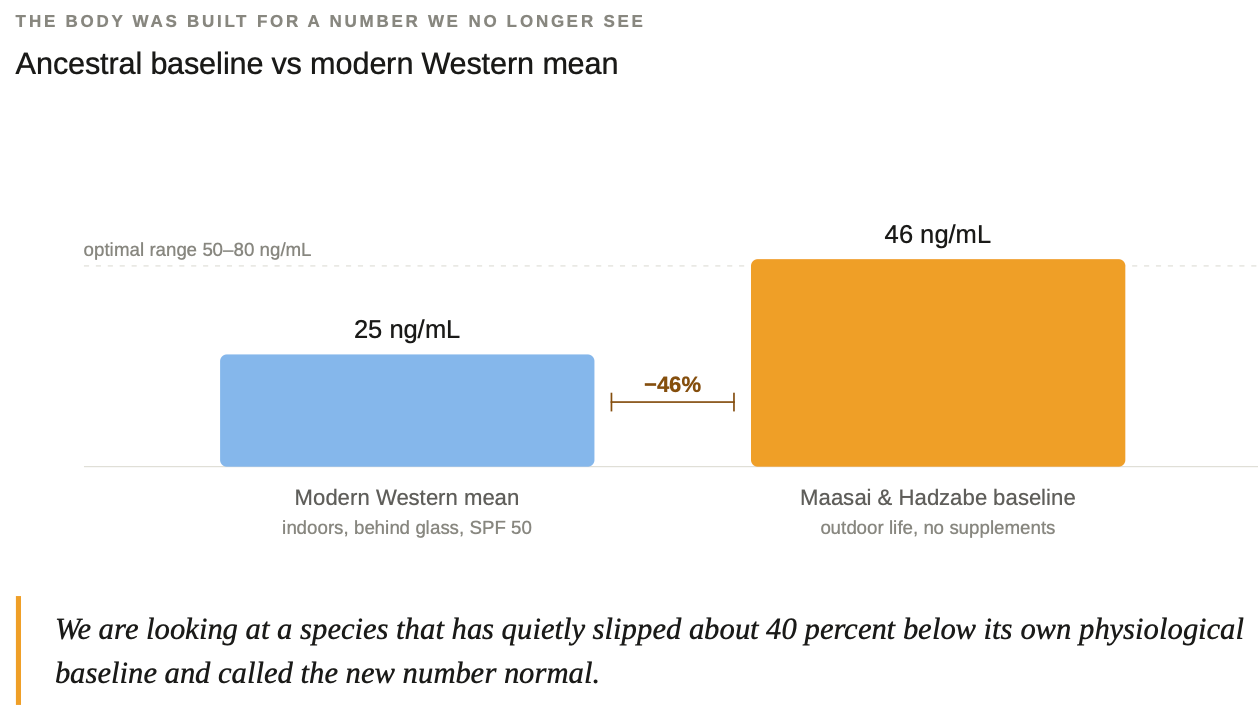
We have an answer. Researchers measured traditional Maasai pastoralists and Hadzabe hunter-gatherers in East Africa, people with the darkest skin type, living outdoors, but sensibly clothed and avoiding the midday sun. Their mean 25(OH)D sat at 46 ng/mL. No supplements. No fortified cereal. No capsules. Just a body doing what a body does when you stop hiding it from the star it evolved underneath.
The modern Western mean, by contrast, hovers around 25 ng/mL. Roughly half of what the body produces when left alone
The ancient traditions, as always, understood this without needing a lab. Sun worship was never worship of a deity pretending to be a star. It was the intuitive recognition that something in the light was feeding something in the body. Every contemplative tradition I can think of, from the Vedic Surya namaskar to the early Christian monastics rising with the dawn to the Sufi practices of prayer times tied to the sun’s arc, placed the human being in deliberate, daily contact with morning and midday light. They did not know about CYP2R1 or the vitamin D receptor. They knew, because they paid attention, that a body left in darkness quietly falls apart.
Peer-reviewed science is, once again, catching up to what the mystics knew.
The scale of the deficiency
A 2023 pooled analysis of 7.9 million participants across 79 countries found that 47.9 percent of the global population is below 20 ng/mL, and 76.6 percent is below 30 ng/mL. In the United States, NHANES data show roughly 40 percent are frankly deficient and only about one in three adults reach even the conservative sufficiency line. Among non-Hispanic Black Americans, about 60 percent sit below 20 ng/mL at any given time. Among the elderly, nearly 60 percent globally are deficient.
These are not edge-case numbers. This is the most widespread nutritional inadequacy on the planet, and it tracks almost perfectly with the geography of modernity: indoor work, indoor leisure, sunscreen as a daily ritual, air pollution scattering UVB, clothing norms that keep the skin hidden, and a dietary landscape largely stripped of the fatty fish and animal fats our ancestors lived on.
The deficiency is not a mystery. It is the predictable biological signature of a life lived indoors, under fluorescent light, behind glass, wearing SPF 50, eating food that no longer includes the organs and fats our ancestors treated as sacred.
Now back to her question
Keep in mind the client I was consulting with for a moment. She is sitting at 28 ng/mL, exhausted, shedding hair, wondering whether the vitamin she has been quietly avoiding because of a headline is the same vitamin her body has been begging for. Her fear is specific. An 80 percent rise in poisonings. She is not asking me for a meta-analysis. She is asking me whether the vitamin will hurt her.
To answer her honestly, I must walk through what that headline actually says, and what it leaves out. Stay with me through the numbers. Her resolution is on the other side.
The headline
In 2025, a group of Korean researchers published an analysis in Nutrients of U.S. National Poison Data System records. Their finding, which then detonated across wellness media and mainstream health coverage, was that vitamin D-related poison control calls rose 78 percent between 2012 and 2022, from roughly 5,900 to about 10,500 per year. An earlier window from 2005 to 2011 showed a 1,600 percent increase.
Those are real numbers. I have no interest in pretending otherwise. But a number stripped of its denominator and its definition is not information. It is sensationalism.
Let me walk through what the report contains and what it does not.
What a poison control call is
An entry in the National Poison Data System is not a diagnosis of toxicity. It is a logged contact. A parent whose toddler chewed two gummies and called to ask if they should worry generates the same record as a hospitalized patient with serum calcium of 14. A pharmacist ringing with a question about a dosing error is a case. A worried adult who accidentally took their supplement twice is a case.
The foundational analysis of this data, conducted by Spiller and colleagues across 25,397 vitamin D exposure calls from 2000 to 2014, found zero deaths, 5 major effects (0.02 percent), and 156 moderate effects (0.61 percent). The proportion of callers who needed medical evaluation dropped from 19.1 percent in 2001 to 9.3 percent in 2013, even as the raw call volume climbed. In other words, the calls were getting less serious, not more.
The denominator the headline forgot
Between 2015 and 2020, American vitamin D supplement use rose by about 10 percentage points. In 2020 alone, during the pandemic, vitamin D sales grew 34.4 percent, and an industry survey found that 80 percent of Americans were using some kind of supplement, the highest figure in 20 years. Conservative estimates now place the U.S. vitamin D-using population somewhere between 50 and 100 million people.
At the peak year of 10,500 poison control calls, that works out to roughly 0.01 to 0.02 percent of users generating a call at all, most of which are resolved with reassurance. The serious-outcome fraction is vanishingly smaller than that.
The number that should anchor this whole story
A 78 percent rise in calls against a doubling of the user base means per-capita risk did not go up. It went down. The headline was measuring how many more people are taking vitamin D, not how dangerous vitamin D became.
The threshold they called toxic
The Korean paper’s primary potentially toxic threshold was set at 50 ng/mL. I want you to hold that number in mind, because it is the hinge of the entire controversy.
Fifty ng/mL is squarely inside the Endocrine Society’s 2011 sufficient range of 30 to 100 ng/mL. It is below the 50-80 ng/mL target that most progressive clinicians aim for. True clinical vitamin D toxicity, the kind that produces hypercalcemia, nephrocalcinosis, and the cardiac and renal consequences people fear, reliably requires serum levels above 150 ng/mL, and more often well above that.
The Mayo Clinic’s ten-year retrospective of 20,308 patients found that 8 percent had levels above 50 ng/mL with no increased risk of hypercalcemia, and they documented exactly one case of true toxicity, in a patient taking 50,000 IU per day for more than three months, who reached 364 ng/mL. A separate academic medical center review of 127,932 serum measurements from 73,779 patients found that only 0.12 percent exceeded 120 ng/mL, and of those, only 4 individuals showed any symptoms, three of which were traced back to errors in concentrated liquid formulations.
One of those patients, remarkably, had a 25(OH)D of 850 ng/mL with completely normal plasma calcium and no symptoms at all.
The largest randomized trial in history, VITAL, gave 25,871 adults 2,000 IU of vitamin D3 daily for over five years and recorded no excess hypercalcemia, no excess kidney stones, no adverse safety signal whatsoever.
What the headline was really measuring
If you strip away the framing, the Korean report is measuring three things layered on top of one another. It is measuring a population that finally began taking vitamin D during a pandemic in which vitamin D deficiency was openly linked to severe respiratory outcomes. It is measuring a supplement user base that roughly doubled in a decade. And it is measuring a handful of genuine cases that, almost without exception, trace back to manufacturing errors, mislabeled products, or extraordinary daily doses sustained for months.
The things the report is not measuring are equally important. It is not measuring deaths because there are essentially none. It is not measuring chronic low-level harm, because no such signal exists in the long-term data. It is not measuring the toll of the deficiency, the headline is implicitly asking people to remain in.
Compare vitamin D to acetaminophen, a drug most people keep in their bathroom without a second thought. Acetaminophen is responsible for roughly 500 deaths per year in the United States, over 100,000 poison control calls annually, and 46 percent of acute liver failure cases. Vitamin D, in 25,397 exposure reports over 15 years, was associated with zero deaths. The asymmetry in public alarm is not scientific. It is cultural.

Why the guidelines went the wrong way
The 2024 Endocrine Society guideline, which advises against routine 25(OH)D testing in healthy adults, including those with dark skin and obesity, relied almost exclusively on randomized controlled trials. On the surface, this sounds like rigorous medicine. In practice, it is the wrong instrument for the question.
The major trials, VITAL among them, enrolled populations whose mean baseline 25(OH)D was already around 30 ng/mL. Many participants in the placebo arms were permitted to continue taking up to 1,200 IU of their own supplemental vitamin D. Asking whether supplementing a mostly sufficient population yields additional benefit is a fundamentally different question from asking whether correcting a deficiency produces a clinical effect. The first question is what the guideline answered. The second question is what the patient is asking.
The original Institute of Medicine RDA of 600 IU per day, which the 2024 guideline quietly defers to, contains a documented statistical error. Veugelers and Ekwaru showed, using the IOM’s own dataset, that the correct intake to bring 97.5 percent of individuals above even the conservative 20 ng/mL threshold is closer to 8,895 IU per day. The error was not subtle. It was roughly fifteenfold. It has never been formally corrected.
We are operating under a public health recommendation that, by its own authors’ math, is off by more than an order of magnitude, while being told that asking for a blood test to find out where you stand is unnecessary.
The part almost no one is measuring
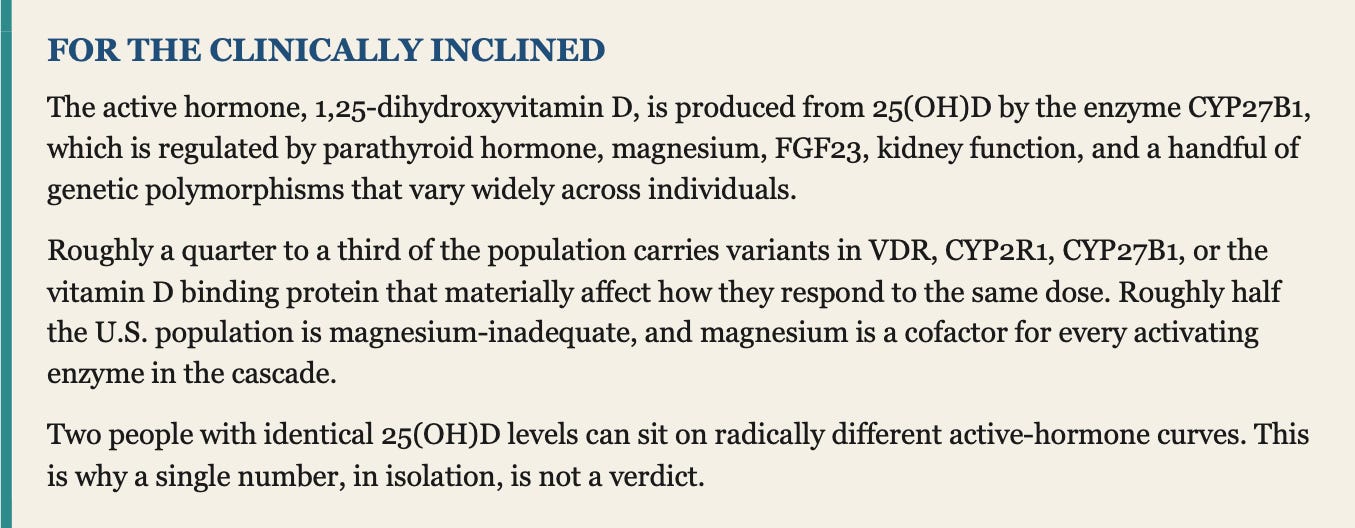
Even when clinicians do test, they almost always test only 25(OH)D. This is the storage form. It is a useful index of how much vitamin D your body stores. It tells you essentially nothing about whether the warehouse is being unloaded.
Measuring only 25(OH)D is like measuring only T4 and declaring the thyroid understood. It is a starting point, not an endpoint.
Your protocol, as a checklist
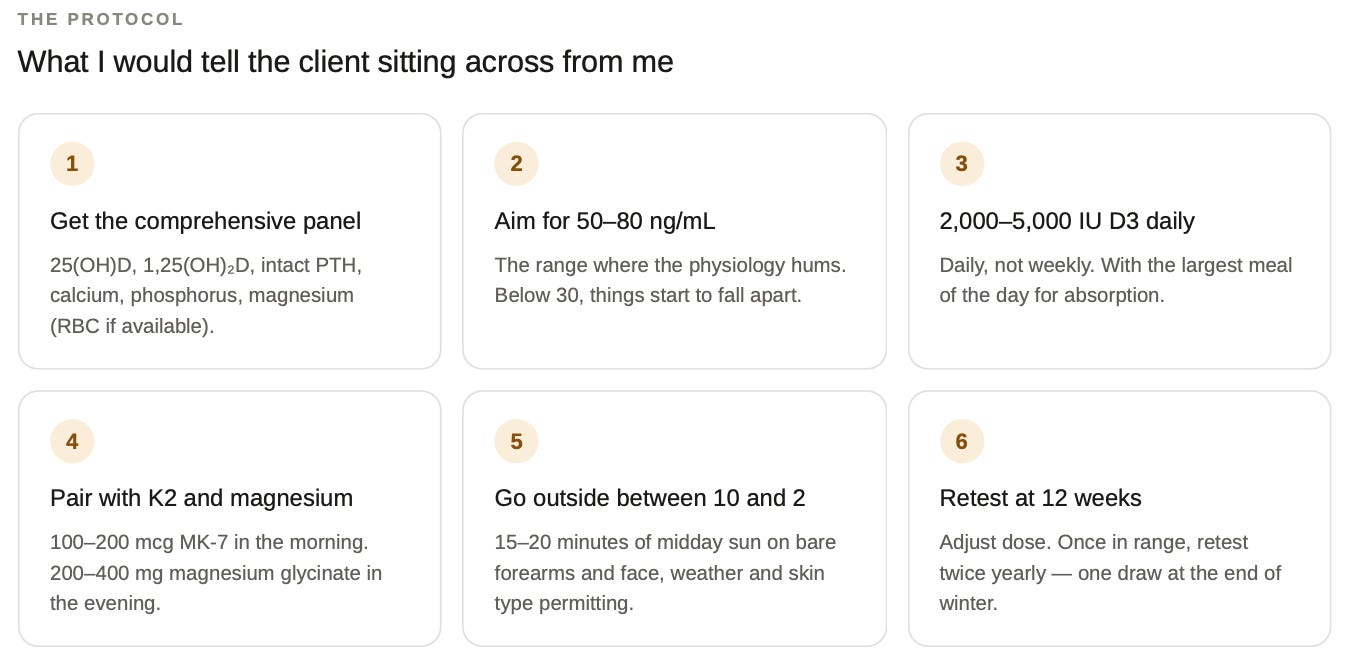
This is what I would tell the client sitting across from me. It is also what I would do if I were the patient.
The capsule is the apology we owe our biology for the life we have arranged. It is not the goal.
Her resolution
The client I opened with started on 5,000 IU of D3 daily, with K2 and magnesium glycinate in the evening, and a standing instruction to spend fifteen minutes outside, face and forearms uncovered, between ten and two, whenever the weather allowed. We retested at twelve weeks. Her 25(OH)D was 58 ng/mL. Her fatigue had lifted. The hair on her pillow had slowed to a trickle. Her mood, in her own words, had come back online.
I am not claiming vitamin D is a miracle. I am claiming it is a birthright that modernity has quietly stripped from most of the people reading this, and that the latest round of headlines is asking you to stay stripped of it based on a statistical artifact.
Read the report. Read the denominator. Ask where the toxicity threshold was set and whether the number makes physiological sense. Ask whether a species that evolved under a star should really be afraid of the star.
And then, if you can, go outside.
Health is a verb.