

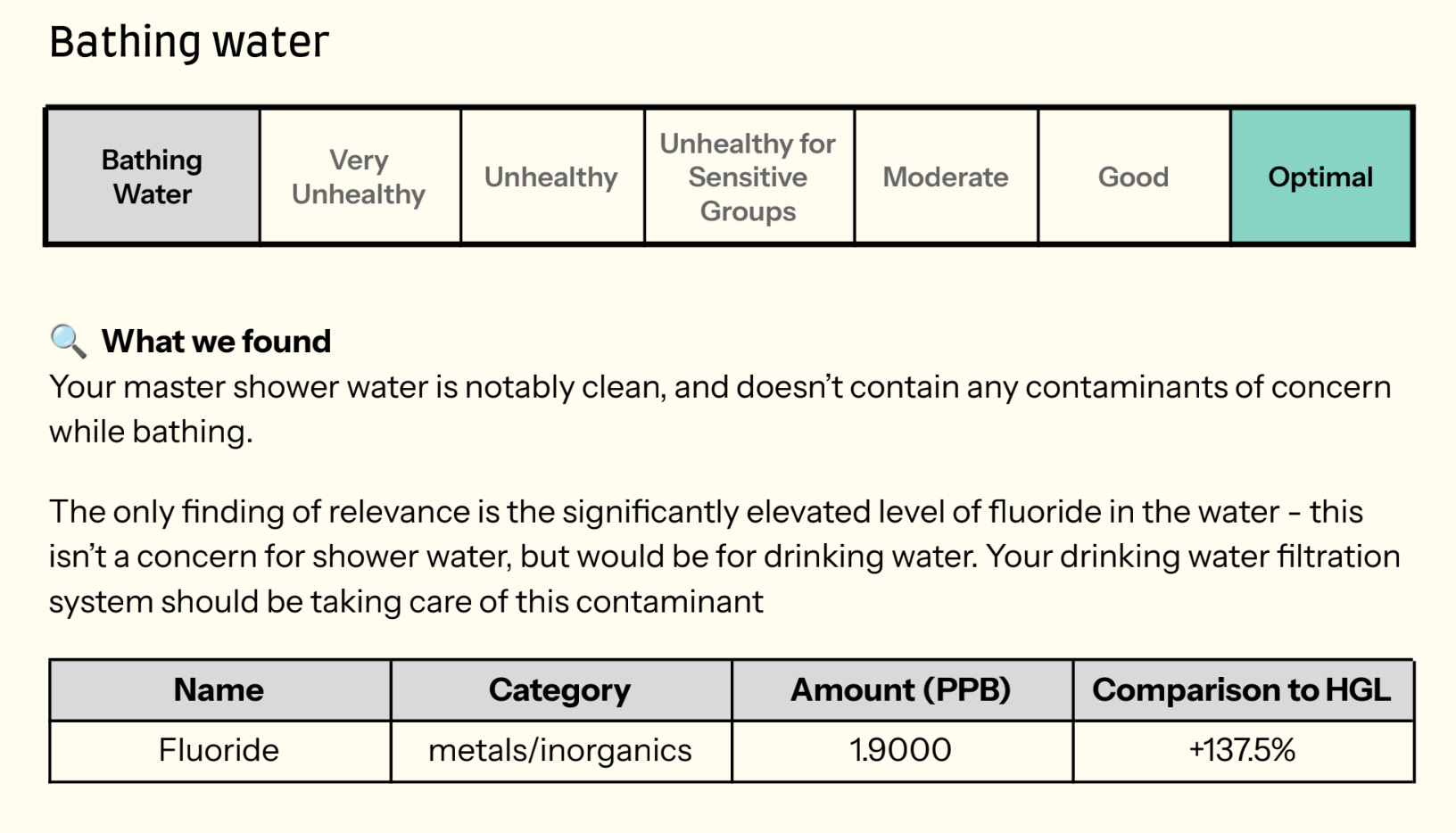
We recently had a home health assessment from Lightwork Home Health (https://www.lightworkhome.com/), and I was on a video call with them reviewing our report – air quality, EMF, light quality – all excellent. Water, which I never considered would be an issue since we are on well water, have a whole house filter with UV light and a reverse osmosis system for our drinking and cooking, but our water report said fluoride 1.9 parts per million!
I sat with that number for a moment, feeling something shift in my understanding. This wasn’t the fluoride added by municipal water treatment. This was geological fluoride, leached from the limestone bedrock of the Edwards Aquifer over thousands of years. The same ancient rock that filters our water had been quietly dosing it with a concentration nearly three times higher than what municipalities deliberately add.
Health(v.) is a reader-supported publication. To receive new posts and support my work, consider becoming a free or paid subscriber.
The irony struck me immediately. Our home had well water, not municipal water. Yet here was nature dissolving minerals from volcanic deposits and fluorite-bearing rock formations, creating concentrations that exceed EPA secondary standards. The deep aquifer beneath our Hill Country property, with its karst fractures and extended contact time with bedrock, had been mixing us a mineral cocktail that no water treatment plant would dare formulate.
Fortunately, every drop of our drinking and cooking water runs through an under-sink reverse osmosis system. That investment had been quietly protecting us. The fluoride level is not an issue for bathing, showering, or brushing our teeth; it becomes an issue only if swallowed. But the discovery opened a deeper question: how many other families drawing from deep wells in the Edwards Aquifer region have no idea what they’re drinking?
This moment crystallized something I’d been circling in my research for months. The conversation about water quality has been hijacked by false binaries: tap versus bottled, natural versus treated, pure versus contaminated. The reality is far more complex, far more interesting, and far more essential to understand.
Because water is not just another nutrient, it is the medium in which every single process of life occurs.
The Forgotten Brilliance of Water
For 12,000 years of stable civilization, humans understood something about water that we’re only now rediscovering through peer-reviewed research: it’s not a passive substance to be consumed, but an active, intelligent participant in every physiological function.
Ancient healing traditions spoke of water as carrying vital energy, of springs possessing medicinal properties, of the profound difference between “living” and “dead” water. Western science dismissed these observations as prescientific superstition, the kind of primitive thinking that vaccination and chlorination would eventually replace.
Then we started measuring what they’d been observing.
Water comprises 50 to 75 percent of your total body weight. Water molecules stabilize the double helix of your DNA, maintain the three-dimensional architecture of your proteins, create the hydrostatic pressure that gives your cells their shape. The water layered directly against these macromolecules behaves differently from bulk water, a phenomenon researchers now call “biological water.”
At the molecular level, water is a chemical reactant, not just a solvent. Every act of digestion involves hydrolysis, in which enzymes use water molecules to split proteins into amino acids and carbohydrates into glucose. Every construction of complex molecules requires condensation reactions that remove water. In photosynthesis, water itself is the reactive substrate that gets oxidized to generate oxygen.
Scale up from the molecular to the systemic, and water’s intelligence becomes even more apparent. Your body’s thermoregulation depends on water’s exceptional heat capacity, its ability to absorb and dissipate enormous amounts of thermal energy through evaporation. Even at low levels, dehydration neutralizes the thermoregulatory advantages of high aerobic fitness. The blood itself is a water-based transport system that carries oxygen and nutrients to cells while removing urea, excess sodium, and metabolic waste.
When water intake drops below roughly 500 milliliters daily, the body enters not mere discomfort but metabolic crisis. Digestion slows. The gut loses motility. Vasopressin levels spike, disrupting glucose management and causing the body to confuse thirst signals with hunger cues. This cascade leads to overeating, bloating, constipation, and a fundamental dysregulation of energy.
What science has revealed is that the source of that water matters far more than anyone imagined.

The Source Matters More Than You Think
The fluoride reading in my well water was a reminder: the earth is not a passive filter. It’s a chemical laboratory, and groundwater is the solvent moving through it.
Every water source carries a signature, a mineral profile shaped by the geology it passes through, the time it spends in contact with rock, the depth from which it’s drawn. These signatures have profound health implications that our ancestors understood empirically and that modern epidemiology is now quantifying with precision.
The Hard Truth About Soft Water
Water softeners remove “scale-causing” minerals like calcium and magnesium, making water better for plumbing, easier on appliances, and softer on skin. The implicit message: minerals are nuisances to be eliminated; purity is the goal.
Epidemiological data tells a different story.
Studies spanning decades, including comprehensive reviews by the World Health Organization, have found a consistent protective association between hard water consumption and cardiovascular disease. Populations drinking mineral-rich water show lower rates of heart disease, ischemic stroke, and overall mortality compared to those consuming soft, demineralized water.
Magnesium appears particularly protective. Regions with naturally high-magnesium water show significantly reduced cerebrovascular disease rates. The mechanism makes sense: these minerals aren’t contaminants, they’re essential nutrients. Drinking water can provide a substantial portion of daily magnesium intake, and many industrialized diets don’t compensate for their absence.
The traditional practice of seeking out mineral springs and traveling to specific wells known for their healing properties wasn’t superstition. It was a sophisticated empirical observation. Those communities had discovered what labs would later confirm: geology creates medicine.
And geology also creates poison.
When Nature Doses You with Toxins
My fluoride reading of 1.9 ppm comes from the Edwards Aquifer’s contact with fluorite-bearing minerals, apatite deposits, and volcanic rock formations. The deeper the well, the longer the contact time, the higher the concentration. Some wells in our region exceed the EPA’s maximum contaminant level of 4 ppm.
Arsenic provides an even starker example. In regions with volcanic deposits or certain granite bedrock, groundwater naturally dissolves this potent carcinogen from the surrounding rock. It’s colorless, odorless, tasteless. Well owners have no idea they’re consuming it until they test. Long-term exposure increases the risk of skin, bladder, and lung cancers, along with cardiovascular disease and developmental effects.
The Southwest, the Hill Country, and regions with past volcanic activity all carry elevated geological risk. A private well is an unregulated source. The Safe Drinking Water Act doesn’t apply. Testing and treatment are entirely the homeowner’s responsibility.
Boiling doesn’t help. Boiling chemical contaminants like arsenic and fluoride, concentrates them as pure water evaporates away. The traditional practice of boiling for safety works against biological pathogens but amplifies chemical risks.
Ancient communities couldn’t measure these invisible threats. They could however, observe patterns: certain wells caused illness, others promoted health. They developed location-specific wisdom, knowledge that springs from trust. Without spectroscopy or toxicology, they were practicing epidemiology.
What’s changed isn’t the geology. It’s our disconnection from observation, our assumption that “natural” means “safe.”
If you use Berkey water filters, please read this bonus post:
The Berkey Problem: A Valuable Lesson
The Modern Contamination Paradox
If well water carries geological risks, surely municipal water, with its treatment plants and regulatory oversight, solves the problem?
Not exactly.
Municipal water systems represent one of public health’s greatest achievements. The multi-barrier treatment process, coagulation, flocculation, sedimentation, filtration, and disinfection, creates water safe enough to eliminate cholera, typhoid, and dysentery from developed nations. This infrastructure saves millions of lives.
But the system itself introduces new categories of contamination that our ancestors never faced.

The Treatment Risk: Disinfection Byproducts
Chlorine kills bacteria. That’s its job, and it performs brilliantly. However, when chlorine encounters naturally occurring organic matter in source water, it creates a new class of compounds: disinfection byproducts (DBPs), specifically trihalomethanes and haloacetic acids.
Long-term exposure to these DBPs at concentrations exceeding EPA standards has been linked to increased risk of bladder and colon cancers, along with liver, kidney, and central nervous system effects. We’re trading acute, infectious disease for chronic, accumulating toxicity.
The irony is profound. We chlorinate water to make it safe to drink, then create contaminants through that very safety process.
The Distribution Risk: The Post-Treatment Gauntlet
Here’s what most people don’t realize: the water leaving the treatment plant is not the water arriving at your tap.
Between the plant and your faucet lies the distribution system, millions of miles of aging pipes. The interior surfaces of these pipes harbor biofilms, complex matrices of bacteria, fungi, and protozoa. These biofilms protect opportunistic pathogens, such as Legionella pneumophila, from the chlorine residual used to disinfect the water.
As pipes corrode, they leach heavy metals into the water supply. Lead from service lines and old solder, copper from pipe walls. The corrosion process consumes the remaining disinfectant, allowing biofilms to proliferate further. This creates a vicious cycle: corrosion leaches toxins while simultaneously enabling biological contamination.
The Flint water crisis wasn’t an anomaly. It was a revelation. The water was treated correctly at the plant. The contamination happened in the distribution system, in the pipes no one sees, through corrosion that no one monitored.
Thousands of communities have similar infrastructure risks. The pipes are invisible until they fail catastrophically.
The Consumer Deception: Bottled Water and Nanoplastics
Faced with these concerns about tap water, millions of Americans have made what seems like a logical choice: bottled water. It’s marketed as purer, cleaner, safer. Spring water from pristine sources, protected from industrial contamination.
Recent research funded by the National Institutes of Health has revealed something staggering.
Using a new imaging technique called Stimulated Raman Scattering microscopy, researchers analyzed bottled water samples in January 2024. They found an average of 240,000 plastic particles per liter.
This concentration is 10 to 100 times higher than any previous estimate. More importantly, 90 percent of these particles aren’t microplastics but nanoplastics, fragments smaller than one micrometer.
Here’s why size matters: microplastics are likely too large to be absorbed through the gut wall. The body can excrete them. But nanoplastics are small enough to penetrate the intestinal barrier, enter the bloodstream, cross the blood-brain barrier, and even pass through the placenta.
We don’t yet know the long-term health effects. But toxicologists are investigating potential risks including chronic inflammation, cellular oxidative stress, and endocrine disruption.
The source of these particles isn’t environmental pollution. It’s the packaging itself. The PET bottle (which stands for polyethylene terephthalate) sheds fragments. The cap releases particles every time you twist it open. Manufacturing, transportation, and temperature fluctuations all contribute to the plastic load.
Municipal water treatment, with its coagulation and filtration processes, removes the vast majority of microplastics from tap water. Bottled water packages them directly into your drink.
Consumers pay a premium to avoid regulated contaminants in tap water. In exchange, they’re ingesting hundreds of thousands of unregulated, cell-penetrating plastic fragments.
The Purification Trap
Faced with geological risks in well water, treatment byproducts in tap water, and plastic contamination in bottled water, the logical conclusion seems obvious: pure water. Remove everything.
This is where reverse osmosis comes into play. RO systems force water through a semipermeable membrane with microscopic pores as small as 0.0001 microns. The result is hyperfiltered water with 90-99% of dissolved solids removed.
RO eliminates lead, arsenic, nitrates, fluoride, PFAS (”forever chemicals”), bacteria, viruses, parasites. It’s the most comprehensive point-of-use purification technology available to consumers. For families on contaminated wells or in areas with lead service lines, RO provides unmatched protection.
But here’s the problem most RO owners don’t understand: pure water isn’t healthy water.

The Cardiovascular Risk of Demineralization
RO removes everything, including calcium and magnesium, the protective minerals linked to reduced cardiovascular disease. The water that emerges is essentially distilled, with near-zero total dissolved solids.
The last home we lived in had only rainwater collection and a whole-home RO system. We thought this was incredible, pure H2O, until we realized there were no minerals. We were able to add a remineralizer under our kitchen sink.
Multiple studies reviewed by the WHO have linked long-term consumption of demineralized water to increased cardiovascular morbidity and mortality. The mechanism is straightforward: the water provides no essential minerals, and many people’s diets don’t compensate for this deficit.
Children drinking demineralized water long-term show an increased risk of bone fractures and potential osteoporosis development. Hypotonic (low-mineral) water can cause electrolyte loss, leading to fatigue, weakness, and muscle cramps.
The most dangerous property of demineralized water is often overlooked: it’s chemically aggressive.
The Lead-Leaching Paradox
Pure water is acidic. It’s also corrosive. When RO-treated water flows through pipes, it actively seeks to restore mineral equilibrium by dissolving whatever it contacts.
This creates a dangerous situation. A homeowner installs an RO system specifically to remove lead. But the demineralized water that the system produces then leaches lead from the home’s own pipes, solder, and fixtures at an accelerated rate.
You’ve removed lead from the source water, only to have it reappear in your plumbing.
The Two-Step Solution: Shield and Rebuild
This brings us to a critical insight that most RO manufacturers don’t emphasize that purification must always be followed by remineralization.
An RO system without a remineralization cartridge is a health-negative, not a health-positive.
The most beneficial approach is a two-step process:
Step One: The Shield
Install the RO membrane to create a clean slate. Remove the toxins: arsenic, lead, nitrates, fluoride, PFAS, disinfection byproducts, microplastics. This addresses both source risks (geological contaminants in wells) and distribution risks (leaching from pipes, treatment chemicals).
Step Two: The Rebuild
Install a remineralization cartridge as the final stage. This adds back small amounts of calcium, magnesium, and other beneficial minerals. This step process serves two non-negotiable functions.
First, it restores the health-protective minerals linked to cardiovascular benefits. You’re not just removing the bad, you’re replacing the good.
Second, and just as significantly, it raises the water’s pH from acidic to neutral or slightly alkaline. This stabilizes the water, eliminating its corrosive properties. Non-aggressive water doesn’t leach lead. It doesn’t dissolve copper. It flows through your plumbing without attacking it.
Remineralization isn’t a luxury feature for taste. It’s an essential safety measure.
This is the only approach that addresses all the risks identified in the research: it removes geological toxins, treatment chemicals, distribution contaminants, and plastic particles, while preserving (or restoring) the essential minerals that traditional medicine has always known matter.
The iSpring RO under sink system is available for a Black Friday deal on Amazon for under $200, https://a.co/d/gzhs6vs

The Molecular Hydrogen Mystery
Before we synthesize all of this into practical recommendations, there’s one more piece of the puzzle that deserves attention: the alkaline water phenomenon.
Walk into any health food store and you’ll find shelves of alkaline water, bottles promising to “neutralize acid in your body,” prevent cancer, and slow aging. Expensive ionizer machines claim to transform your tap water into a healing elixir.
Most of these claims have no scientific backing. Yet buried within the marketing mythology is a genuine therapeutic agent that science is only beginning to understand.
The pH Fallacy
The human body maintains blood pH in an extraordinarily narrow range around 7.4. This regulation happens through powerful buffering systems involving the lungs and kidneys. Drinking alkaline water doesn’t change your blood pH. It can’t. The buffering systems prevent it.
Claims that alkaline water systemically “alkalizes” the body or neutralizes acid have no scientific support. There’s preliminary evidence it may help some individuals with acid reflux by neutralizing stomach acid, but this is a local effect, not systemic transformation.
The obsession with pH has obscured something far more interesting.
The Real Active Ingredient: Molecular Hydrogen
Many alkaline water machines are water ionizers that produce “electrolyzed reduced water” through electrolysis. This process does create alkaline water at the cathode (negative electrode), but decades of research have conclusively shown that the alkalinity is irrelevant to the health benefits.
The true active ingredient is dissolved molecular hydrogen gas (H₂).
Hydrogen-rich water is the subject of legitimate scientific investigation. Molecular hydrogen acts as a selective antioxidant. Unlike broad-spectrum antioxidants that can interfere with beneficial cellular signaling, H₂ appears to neutralize only the most harmful free radicals (like the hydroxyl radical) while leaving beneficial signaling molecules intact.
Preliminary clinical and animal studies suggest H₂ possesses anti-inflammatory and anti-apoptotic properties. Research shows potential benefits for oxidative stress conditions, improvements in metabolic syndrome markers (reduced cholesterol and glucose), and enhanced exercise recovery.
Conclusion: The Return to Water Wisdom
The fluoride reading in my well water was an invitation to look deeper, to question assumptions, to remember that the earth is not a passive filter but an active alchemist.
For 12,000 years, humans understood that water carried more than hydration. It carried minerals, vitality, medicine, and sometimes poison. Communities developed location-specific wisdom about which springs to trust, which wells to avoid, how to recognize the signs of good water versus bad.
Then we built infrastructure, treatment plants, and regulatory agencies. We gained protection from acute infectious disease but lost the intimate knowledge of our sources. We assumed technology had solved the problem completely.
The past century of research has brought us full circle. Epidemiology confirms what traditional medicine observed: mineral-rich water protects the heart. Toxicology reveals what geology always knew: certain rocks poison the water.
Modern science isn’t disproving ancient wisdom. It’s providing the peer-reviewed validation of physiological intelligence our ancestors observed but couldn’t measure.
The body knows what it needs. It signals thirst before organs fail, craves minerals when depleted, responds to the water it receives with either vitality or dysfunction. The question is whether we’ve cultivated the attentiveness to hear those signals, to observe the effects, to make choices based on evidence rather than marketing.
Test your water. Understand your waters source. Filter with purpose. Remineralize with intention.
Your body will know the difference, even if you can’t taste it.
Health(v.) is a reader-supported publication. To receive new posts and support my work, consider becoming a free or paid subscriber.