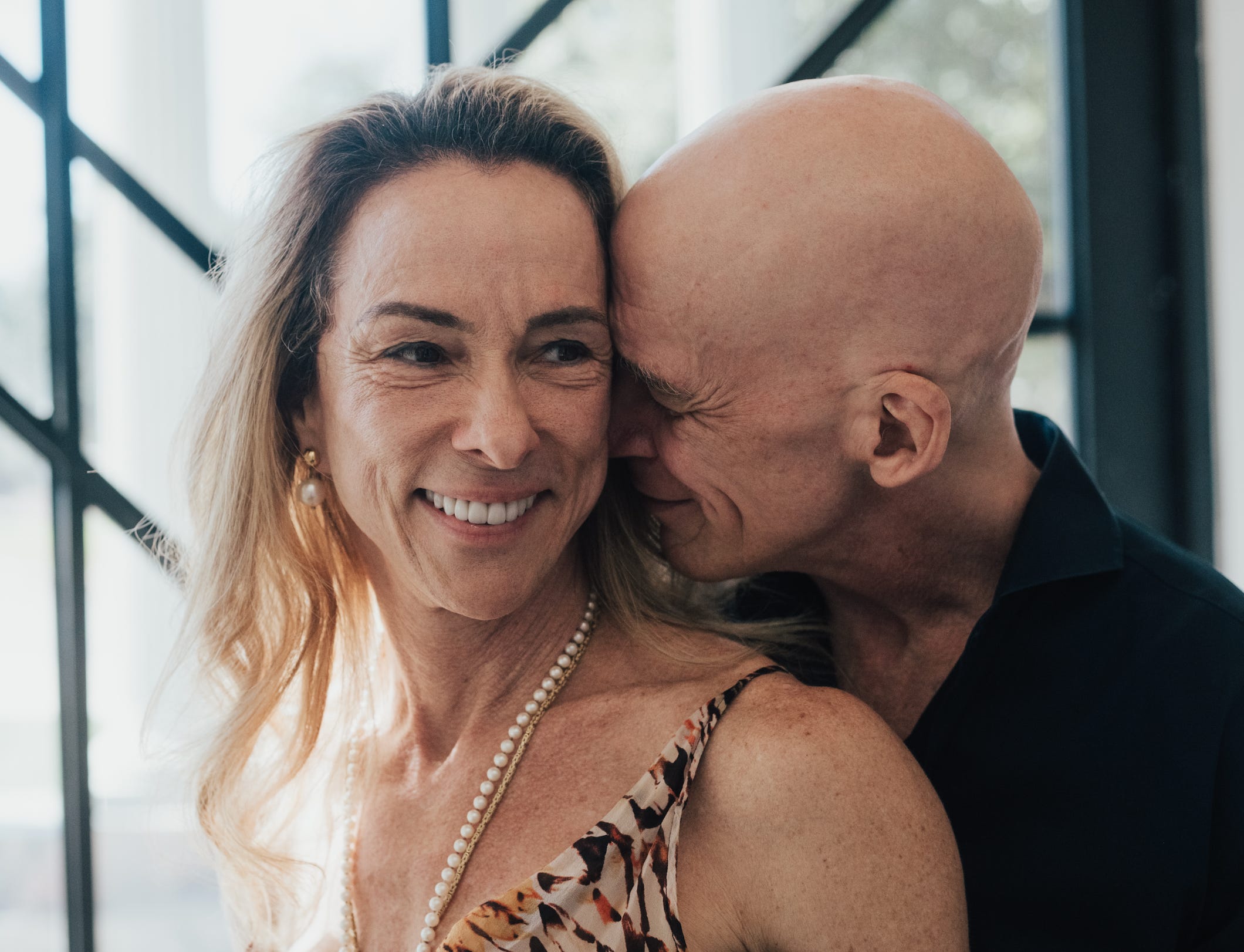
I was born in the mountains of Appalachia, where men hugged each other without apology. My uncles would pull me into their chests at family gatherings, my grandfather’s hand would rest on my shoulder as he told stories of the old days, and every greeting and goodbye was sealed with physical contact. But there was an unspoken boundary. This affection was reserved for blood. Strangers received a handshake. Outsiders received nothing at all.

I carried this programming into adulthood without examining it. When patients would occasionally hug me after an appointment, I felt a strange discomfort rise in my chest. I didn’t understand it. These were people I had cared for, sometimes for years, sometimes through their darkest moments. Yet something in me recoiled from the contact.
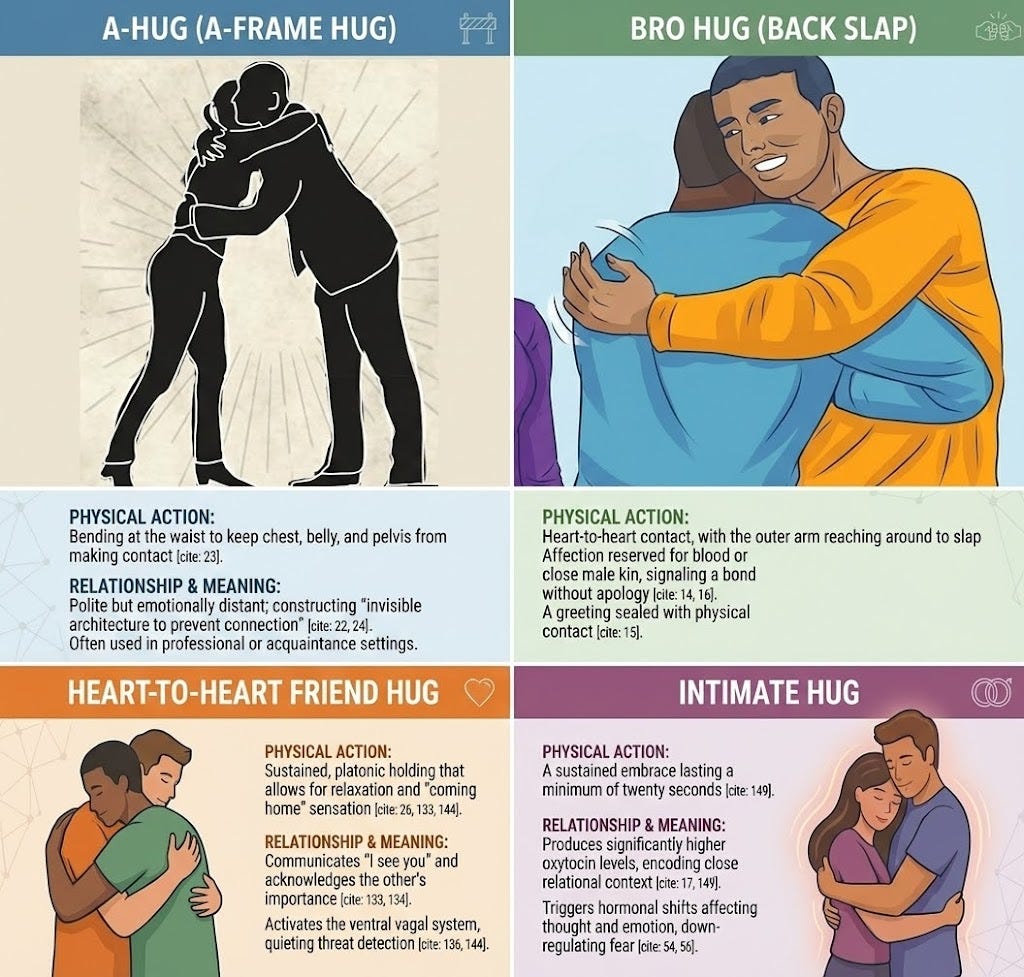
Then I moved my medical practice to Asheville, North Carolina, and encountered a culture that had not received the same programming. The mountain hippies and organic farmers who became my patients were huggers. Not polite huggers. Real huggers. Within weeks, someone pointed out that I was doing what she called “A-frame hugs,” bending at the waist to keep my chest, belly, and (heaven forbid) pelvis from making contact with theirs. I was constructing invisible architecture to prevent connection.
One woman with no patience for emotional avoidance, actually pulled my hips toward hers during a hug to demonstrate what I was missing. I remember the shock of it. The strangeness. And then, underneath the strangeness, not at all sexual, more like coming home.
I had spent decades studying the biochemistry of human health without ever questioning why this simple act felt so profoundly uncomfortable. What I didn’t know is that my discomfort was not a personality quirk. It was a symptom of a culture-wide deficiency disease.
The Caress Detector
For most of medical history, we believed that touch was simply touch. One system of nerves, one type of sensation, one utilitarian purpose: detecting texture, temperature, and pain. We were wrong.
In the past two decades, researchers have discovered that humans possess two entirely separate touch systems. The first is the one we always knew about, the fast-conducting A-beta fibers that tell your brain, “There is a fly on your arm.” This is the touch of facts, of discrimination, of knowing where you end and the world begins.
But there is another system. Hidden in the hairy regions of your skin, comprising up to forty percent of certain nerve branches, lies a network of slow, unmyelinated fibers called C-tactile afferents. These nerves do not care about facts. They care about connection.
The specificity of these fibers borders on the miraculous. They respond optimally only to stroking at a velocity between one and ten centimeters per second, at a temperature near 32 degrees Celsius. In other words, they are precisely calibrated to detect the speed and warmth of a human caress. Too fast, and the signal diminishes. Too cold, and the response dampens. Skin evolved a detection system for the exact quality of loving touch.
When I read the research, I was surprised to find that these fibers do not send their signals to the same brain region as ordinary touch. While the A-beta fibers project to the somatosensory cortex, the analytical brain that maps where sensations occur, the C-tactile afferents bypass this system entirely. They project directly to the posterior insular cortex, the region responsible for interoception, for the felt sense of the body’s internal state.
This means your brain does not process a hug as tactile data. It processes a hug as a homeostatic emotion, in the same category as hunger, thirst, or satiation. Touch, at the neurological level, is not a sensation. It is a nutrient.
The Neurochemical Cascade
When those C-tactile fibers fire, they trigger a cascade of hormonal shifts that would have seemed like alchemy to physicians a generation ago.
First comes oxytocin, the molecule of trust. Released from the hypothalamus, oxytocin flows both into the brain (affecting thought and emotion) and into the bloodstream (affecting physiology). It down-regulates the amygdala, your brain’s fear center, reducing the constant vigilance that modern life demands. Studies show that partner touch produces significantly higher oxytocin levels than touch from strangers, suggesting the brain encodes relational context into the hormonal response itself.
Then come the endogenous opioids, beta-endorphins, your body’s own painkillers. This explains the instinct that every parent knows without being taught: when a child bumps their shin, you rub it. You are not merely comforting them psychologically. You are literally closing the gate on pain signals through a mechanism that neuroscientists call the gate control theory. The gentle pressure of your hand activates large-diameter nerve fibers that suppress the transmission of pain signals to the brain.
Simultaneously, sustained touch lowers cortisol, the stress hormone that, in chronic excess, suppresses immune function, disrupts sleep, inflames tissues, and accelerates aging. Massage therapy produces cortisol reductions that persist for days after a single session, with cumulative effects building over time.
Dopamine rises. Serotonin rises. The entire neurochemical orchestra shifts from a minor key to a major one. And all of this happens below the level of conscious thought, triggered not by belief or intention, but by the simple physics of skin meeting skin at the right speed and temperature.
What the Ancients Knew
None of this would have surprised the traditional healers whose knowledge Western medicine spent centuries dismissing.
Traditional Chinese Medicine, codified over two millennia ago in the Yellow Emperor’s Inner Canon, mapped the body as a network of meridians through which vital energy flows. Three hundred and sixty-five acupoints serve as intervention sites where touch can regulate physiological function. Modern research now validates what the ancient physicians observed: these acupoints correspond to anatomical locations rich in nerve endings, blood vessels, and the fascia that weaves through every tissue.
Indigenous healing traditions across continents describe touch as elemental medicine, humanity’s original tools: hands, heart, and connection with Spirit. West African traditional bone setters, Native American healing practices, Ayurvedic massage, all share the understanding that the healer’s hands serve as conduits for something that cannot be fully reduced to biomechanics. The sensation of heat reported during Reiki sessions, long dismissed as imagination, correlates with measurable vasodilation and increases in beta-endorphins of approximately eighteen percent in chronic pain patients.
The heart itself, which these traditions universally identified as a center of intelligence, generates an electromagnetic field roughly five thousand times stronger than the brain’s. This field is detectable by magnetometers several feet from the body. When individuals touch or sit in close proximity, their heart rhythms begin to synchronize, a phenomenon researchers call “entrainment.” What the mystics called “heart to heart transmission” turns out to have a measurable electromagnetic substrate.
The fascia, that continuous web of connective tissue that envelops every muscle, bone, and organ, functions as what some researchers call a “body-wide internet.” It contains more sensory receptors than any other tissue. When pressure meets skin, the mechanical signal does not merely register at the surface. It ripples through the fascial network, deforming cells down to the level of DNA, triggering what scientists call mechanotransduction, the conversion of physical force into biochemical signals that affect gene expression throughout the body.
Ancient healers knew none of this terminology. They simply observed what happened when they laid hands on the sick: sometimes the body remembered how to heal.
The Grooming Gap
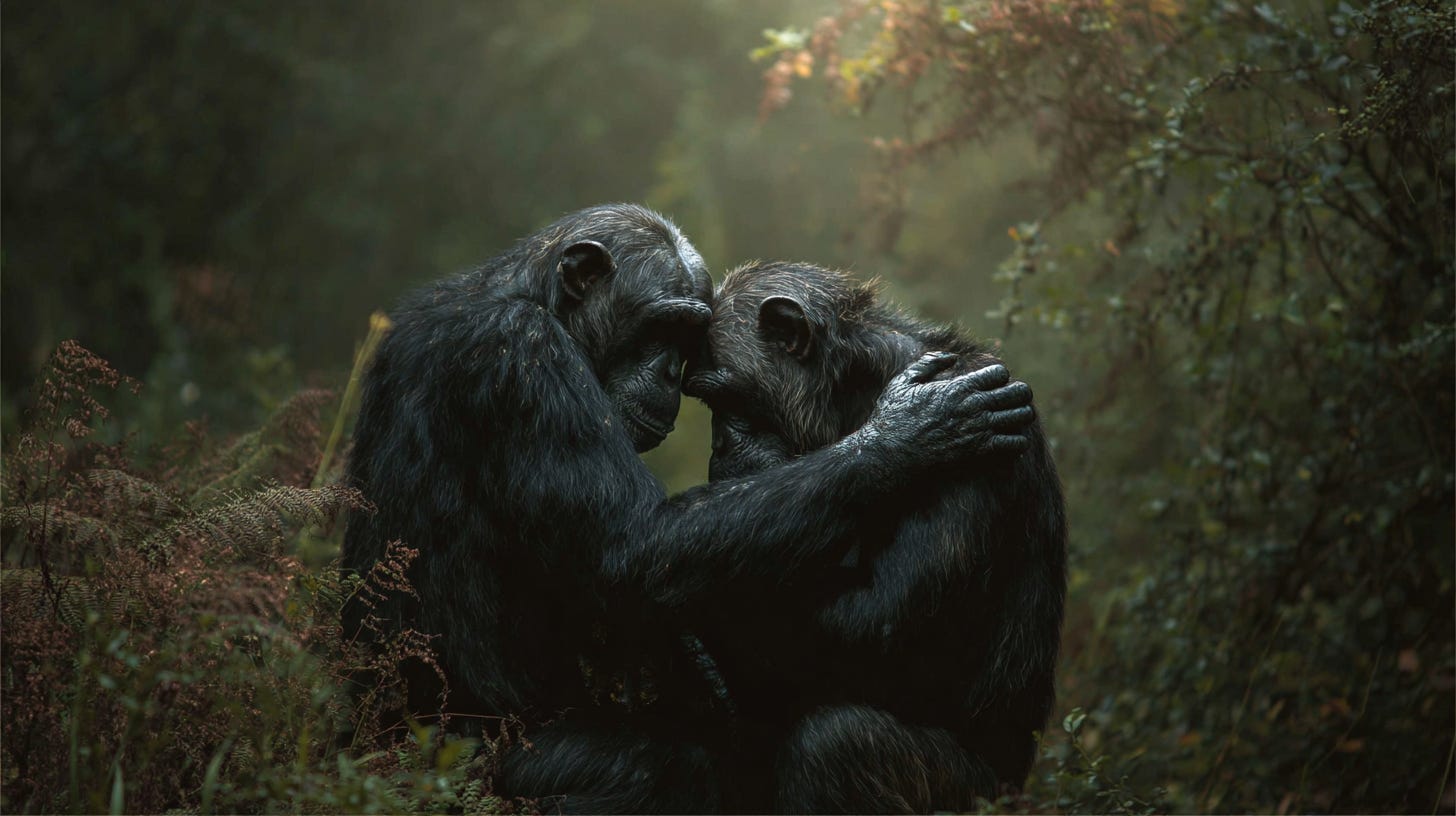
Our primate cousins spend up to twenty percent of their waking hours engaged in social grooming. Not because they need that much hygiene. The fur-picking is almost incidental. What they need is the flood of beta-endorphins that grooming triggers, the psychopharmacological reward that keeps them bonded to their tribe, protected within the group, alive.
Anthropologist Robin Dunbar proposed that as human social groups grew larger than the hundred and fifty or so individuals that physical grooming could maintain, we evolved language as a form of “vocal grooming.” We could now groom multiple relationships simultaneously through speech. The efficiency was extraordinary. The cost was hidden.
Language lacks the physiological intensity of touch. We became, in Dunbar’s phrase, “cognitively connected but physically malnourished.” And then modernity arrived to deepen the famine.
Our ancestors slept in communal groups, bodies touching throughout the night, nervous systems co-regulating in the darkness. An infant separated from skin-to-skin contact experienced an immediate drop in body temperature and heart rate irregularities. The human nervous system did not evolve to self-regulate. It evolved to sync its biological rhythms with others. Modern isolation forces each of us to perform, alone, a task our physiology assumes will be shared.
The Touch Void
In low-contact cultures, which now include most of Northern Europe, North America, and East Asia, a “no-touch” policy has become the implicit or explicit norm in schools, workplaces, and public spaces. The intentions were often good: preventing harassment, protecting boundaries, avoiding litigation. The unintended consequence has been a complete sterilization of platonic touch.
Touch starvation, which researchers now call “skin hunger,” has been recognized as a legitimate psychological condition. Its symptoms include aggression, irritability, depression from depleted serotonin, and a phenomenon called alexithymia: difficulty understanding one’s own emotions. This last symptom makes sense given what we know about the insular cortex. If affective touch is the primary pathway through which we learn to feel ourselves, then touch deprivation is, quite literally, a disconnection from interoceptive intelligence.
The most devastating evidence comes from the Romanian orphanages. After the Ceaușescu regime collapsed, researchers gained access to institutions housing over one hundred thousand children who had received adequate physical care but near-total absence of emotional responsiveness and individualized touch. These children showed persistent deficits across every developmental domain: attachment disorders, cognitive impairment, language delay, and brain abnormalities visible on neuroimaging.
Even after adoption into loving families, many carried the effects into adulthood. The early deprivation had written itself into their nervous systems in ways that would require years of patient, consistent presence to gradually rewrite. The body keeps the score of what it lacked, though research on adult neuroplasticity suggests the capacity to receive what was denied is never entirely lost, only buried deeper, requiring more intention to reach.
The Epigenetic Inheritance
Perhaps the most startling discovery in this field comes from the laboratory of Michael Meaney, whose research on rat maternal behavior revolutionized our understanding of how early touch shapes the body for life.
Rat mothers naturally vary in how much they lick and groom their pups. Offspring of high-licking mothers show decreased stress reactivity, enhanced cognitive function, and more nurturing behavior as adults. Offspring of low-licking mothers become anxious, cognitively impaired, and neglectful of their own offspring.
The mechanism is epigenetic. Maternal licking changes the methylation patterns on the glucocorticoid receptor gene in the pup’s hippocampus. More licking means less methylation, which means more receptor expression, which means a more tightly regulated stress response. The mother’s tongue, through physical contact alone, reaches into the genome and adjusts the settings on her offspring’s stress system.
Cross-fostering experiments proved this was not genetic inheritance. Pups born to low-licking mothers but raised by high-licking foster mothers developed the stress-resilient phenotype of their foster mother’s biological offspring. The programming came through touch, not through DNA.
In humans, similar patterns emerge. Preterm infants receiving skin-to-skin kangaroo care show different gene expression patterns related to stress response, immune function, and neurodevelopment. The World Health Organization now recommends immediate skin-to-skin contact for all newborns without exception. Touch, it turns out, is not optional care. It is the signal that tells the developing genome how to calibrate itself for the world it is entering.

The Return
Years after that woman in Asheville pulled my hips toward hers, I moved to Austin, Texas, and found myself in a culture that had pushed even further beyond my Appalachian programming.
At social gatherings, I encountered what people called “cuddle puddles,” rooms lined with pillows and blankets where people would lie together, touching and holding in ways that were explicitly platonic. After politely asking, a stranger might begin massaging my shoulders in a way that communicated something simple: I see you. I acknowledge you as a person who matters.
The first time I experienced this, I felt my nervous system move through stages of response. The initial startle of unfamiliar touch. The gradual settling as threat detection systems found no threat to detect. And then something deeper: a relaxation I did not know I had been waiting for, as though some part of me had been braced against the world for decades and was only now being given permission to soften.
I understand now what was happening in neurological terms. My ventral vagal system was activating, my amygdala was quieting, oxytocin was flowing, cortisol was dropping. But the scientific explanation does not capture the phenomenology. What I felt was not a chemical cascade. What I felt was being held.
Practical Restoration
If touch is a nutrient, then restoring it requires the same practical attention we would give to any other deficiency.
For those with partners or close family, the research suggests that twenty seconds of sustained embrace is the minimum threshold for triggering significant oxytocin release. Brief social hugs do not reach this threshold. The nervous system requires duration to shift states.
The 20-Second Rule - When you hug, count three deep breaths together. That is approximately 20 seconds.
For those living alone, the options are less obvious but still available. Professional massage should be viewed not as luxury , it’s a “Scheduled ‘Manual Cortisol Therapy’ (Massage), a cortisol management strategy with measurable effects on immune function, inflammation, and mood. Weighted blankets, which provide the deep pressure stimulation that mimics being held, can partially substitute for human contact. Professional cuddling services, which have emerged to address this exact deficit, offer platonic holding in safe, boundaried environments.
Self-touch practices, including placing a hand on your heart or belly during moments of stress, activate some of the same pathways. The research on this demonstrates that even self-administered touch, delivered with awareness and intention, can elevate salivary oxytocin and shift autonomic tone. Your nervous system responds to the gesture of care regardless of its source.
Havening is another option

For parents, the implications could not be more urgent. Skin-to-skin contact in infancy shapes gene expression in ways that persist for decades. The kangaroo care that was once reserved for premature infants should be the default for all newborns. Hold your children. Hold them longer than efficient parenting would suggest. You are not merely comforting them. You are calibrating their stress systems, shaping their capacity for emotional regulation, laying down the epigenetic foundation of their resilience.
The Intelligence of the Body
What strikes me most, reviewing this research, is how long Western medicine ignored what every grandmother knew. Touch heals. Isolation harms. The body is not a machine that functions independently of relationship. It is a relational organ, calibrated by evolution to sync with other bodies, to co-regulate rather than self-regulate, to exist in the electromagnetic and biochemical field of community.
The ancient healers who laid hands on the sick were not practicing superstition. They were activating precisely the pathways were activating the pathways that modern neuroscience has mapped: vagal tone shifts, oxytocin release, cortisol reduction, immune enhancement, epigenetic modification. They simply lacked the instruments to measure what they were doing. The instruments have now arrived. The measurements confirm what the body always knew.
Modernity has given us many gifts. It has also stripped us of the physical contact our nervous systems require for homeostasis. We have become, as a culture, touch-starved in a way that our ancestors could not have imagined. The epidemic of anxiety, depression, and loneliness that afflicts the developed world is not primarily a psychological phenomenon. It is a physiological one. We are mammals deprived of mammalian contact, primates without grooming partners, social animals forced into solitary regulation.
The way back is not complicated. It requires only that we recognize touch as what the research now confirms it to be: not an indulgence, not a luxury, not merely pleasant, but a biological necessity as fundamental as food or water. The skin is not a boundary. It is an organ of connection, a sensory surface evolved over millions of years to receive the signal of belonging.
I think of my grandfather’s hand on my shoulder in those Appalachian kitchens, the weight of it, the warmth. He could not have explained C-tactile afferents or oxytocin cascades. But his body knew what to do, and mine knew how to receive it. Somewhere beneath all the programming and avoidance, that knowing remains, waiting to be remembered.
The question is whether we will listen to the body’s ancient wisdom, or continue to starve it in the name of progress.