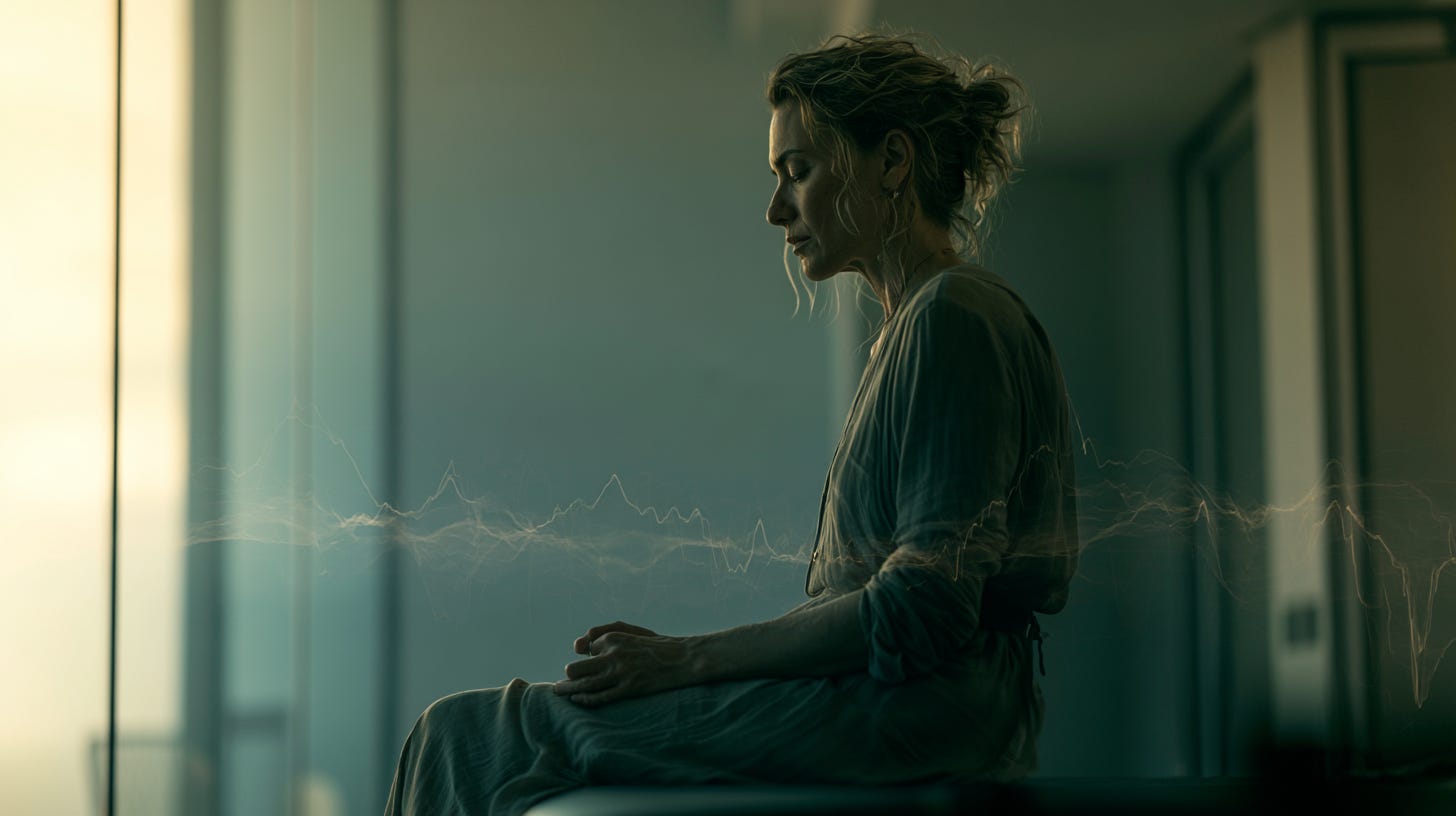
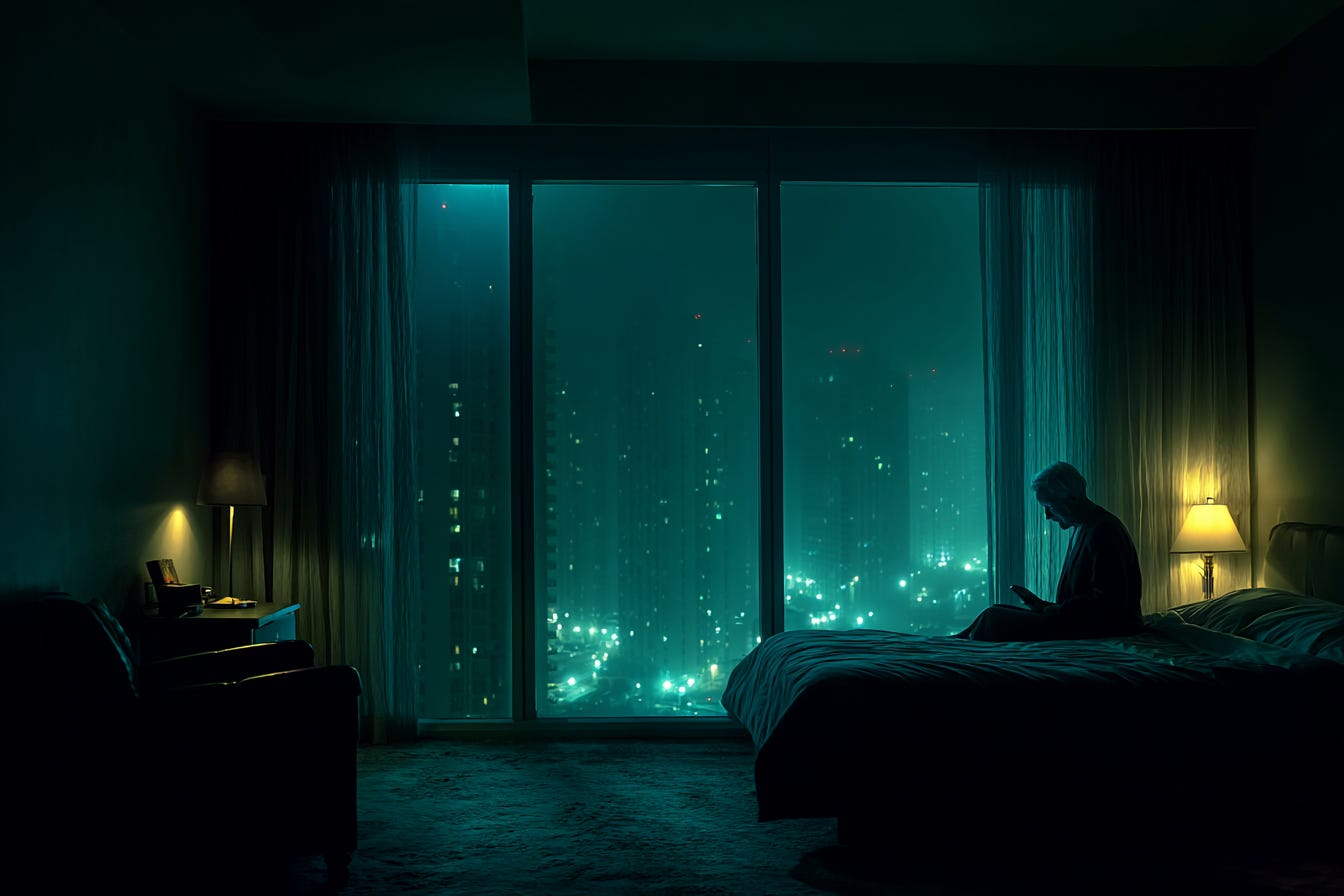
He was fifty-two, and he opened our first session by describing the last several years of laboratory blood chemistries with the resigned authority of a man who has read his own results too many times. Fasting glucose drifting into the prediabetic range despite a wardrobe of running shoes. Total testosterone had quietly slid below four hundred without anyone calling it significant. An LDL particle count that was steadily rising. Resting heart rate elevated even on his recovery ring’s most generous days. And sleep, he could initiate but not sustain, due to a nightly negotiation that ended with him on his phone at three in the morning answering work emails.
He had done everything the optimization culture told him to do. He had a coach, a continuous glucose monitor, a stack of supplements, and a peptide protocol he had ordered from a clinic in Mexico. What he did not have was darkness. He did not have morning sunlight on his retinas before the first Slack notification. He did not have a meal that ended before the sun set. He did not have a single hour in any given twenty-four where his nervous system understood, without ambiguity, what time it was.
His problem was not his testosterone, though his testosterone was suffering. His problem was not his glucose, though his glucose was dysregulated. His problem was that every cell in his body had lost the thread of the conversation. The conductor had walked off the stage, and the orchestra had been improvising for so long that the musicians had forgotten what the symphony was supposed to sound like.
The circadian system is the temporal architecture of life itself, and when it collapses, it takes metabolism, hormones, immunity, and cellular repair with it.
I will return to him. But understanding why his liver dumped glucose at three in the morning, why his testosterone slid without any clinician noticing, and why the most elaborate supplement protocol in his kitchen drawer could not move the needle, requires looking at an oscillator that predates the brain itself.
The Oscillator That Predates the Brain
Chronobiology was once considered a soft science, a curiosity hovering at the edge of real medicine. That era ended in 2017, when the Nobel Prize in Physiology or Medicine was awarded to Jeffrey Hall, Michael Rosbash, and Michael Young for their work on the molecular machinery of the circadian clock. What they revealed, and what a generation of subsequent research has expanded, is that virtually every cell in the human body carries its own autonomous timekeeper.
The suprachiasmatic nucleus, a small cluster of roughly twenty thousand neurons sitting above the optic chiasm, is not the clock. It is the conductor. The clocks are everywhere. Your liver has a clock. Your heart has a clock. Your pancreatic beta cells have a clock. The epithelial cells lining your gut, the fibroblasts in your skin, the osteoblasts building bone, the immune cells patrolling your lymph nodes, all of them run on molecular oscillators.
The mechanism is a feedback loop of four transcription factors: CLOCK, BMAL1, PER, and CRY. They rise and fall in approximately twenty-four hour cycles, turning gene expression on and off.
They do this with a precision that would make a Swiss watchmaker weep with envy.
Current estimates place between 40 and 80% of the protein-coding genome under circadian control. That is not A system, it is THE system. Metabolism, endocrine function, immune regulation, DNA repair, mitochondrial biogenesis, autophagy, and synaptic plasticity all oscillate. The question is whether the rhythm you have bears any resemblance to the one your biology evolved to keep.
Metabolism as a Temporal Event
Glucose tolerance is not a constant. It is a moving target, and the target moves on a schedule. Insulin sensitivity peaks in the morning and declines through the day, reaching its low point in the late evening. The same meal eaten at seven in the morning and seven in the evening produces measurably different glucose and insulin responses. The evening meal is a metabolic insult in a way that the morning meal is not.
Satchidananda Panda (top researcher in time-restricted eating) and his colleagues at the Salk Institute demonstrated this with elegance. Mice given identical calories and identical macronutrients showed dramatically different metabolic outcomes based entirely on when they ate. The mice restricted to eating during their active phase remained metabolically healthy. The mice permitted to graze around the clock developed obesity, hepatic steatosis, insulin resistance, and inflammation despite consuming no additional calories. Time was the variable. Time was everything.
The mechanism is not mysterious. Pancreatic beta cells have clocks. When those clocks are disrupted, insulin secretion becomes disordered. Liver glucose production, lipogenesis, bile acid synthesis, and the enzymes of the citric acid cycle and electron transport chain all show rhythmic expression. Your mitochondria do not simply produce energy. They produce different kinds of energy in different ratios at different times, and they do so by design.
A calorie is not a calorie. It is a calorie consumed at a particular moment, processed by enzymes that are either expressed or repressed depending on what time your liver thinks it is.
This is where the modern metabolic crisis becomes legible in a way that calorie accounting cannot explain. The standard American pattern of eating from waking until moments before sleep, with the largest meal in the evening, is a perfectly designed experiment in circadian misalignment. We are not overfed in the aggregate so much as we are fed at times our biology cannot metabolically accommodate. The damage accumulates silently, measured first as allostatic load, eventually as metabolic disease.
The Hormonal Orchestra
If metabolism is circadian, the endocrine system is its temporal scaffolding. Cortisol does not simply rise and fall. It executes a choreographed awakening response within thirty minutes of first light exposure, peaking at roughly ten to thirty percent above baseline, then declining in a graceful curve through the day. Melatonin begins its ascent roughly two hours before habitual sleep onset, rises through the night, and is suppressed by morning light with ruthless efficiency. Growth hormone pulses predominantly during slow-wave sleep. Testosterone peaks in the early morning, driven by pulsatile luteinizing hormone during the final sleep cycles (REM). Thyroid-stimulating hormone follows its own nocturnal rhythm, with peak release in the late evening and early night.
This is a single integrated circuit, wired so that each signal reinforces and constrains the others. Morning cortisol is supposed to suppress inflammation and mobilize glucose for the coming activity. Evening melatonin is supposed to lower core body temperature, reduce sympathetic tone, and grant cellular permission for repair. When these signals fire at the wrong times, the downstream consequences are not subtle.
Consider the man I described at the beginning. His low testosterone was not primary hypogonadism. It was a downstream casualty of fragmented sleep architecture, because the bulk of testosterone production is driven by pulsatile luteinizing hormone during the final REM cycles, which he was no longer reaching. His drifting glucose was not insulin resistance in the conventional sense. It was the predictable result of a pancreas being asked to secrete insulin during hours its clock had already closed for the night, and a liver dumping glucose into circulation at three in the morning because his cortisol curve had inverted itself. His elevated resting heart rate reflected sympathetic tone that never stood down because his physiology had no clear signal that the day had ended. The body is not broken. It is doing exactly what it is supposed to do in an environment it was never designed to inhabit.
TIP
A time-restricted eating window of ten hours or less, ending three hours before sleep, produces measurable improvements in insulin sensitivity, lipid profiles, and inflammatory markers independent of caloric restriction.
The Ancient Intelligence of the Day
The monastic traditions knew something we have forgotten. The Benedictines divided the day into eight hours of prayer, each tied to a specific quality of light, from Matins at the deepest hour of night through Compline at the boundary of darkness. This was a structured phototherapy protocol disguised as devotion, a thousand-year experiment in entraining human physiology to the solar day.
Ayurveda divides the day into six doshas, each four hours long, each with its own recommended activity, from morning kapha for movement, through midday pitta for digestion and focused work, into the vata hours of creativity and rest. The structure is remarkably consonant with what modern chronobiology measures, and it predates the Nobel Prize by roughly 3,000 years.
Traditional Chinese Medicine maps the twenty-four-hour day onto a body clock in which each two-hour window corresponds to a specific organ meridian. The liver, in this system, holds court between one and three in the morning, which is almost precisely the window in which Western hepatology documents peak hepatic autophagy and bile acid synthesis. The lungs occupy three to five in the morning, the canonical hour for the rising of asthmatic symptoms, now explicable by the circadian expression of bronchial smooth muscle tone and mast cell degranulation. Coincidence is a poor explanation when the correlations are this consistent across traditions that had no communication with one another.
These were empirical systems derived from thousands of years of patient observation, codified into frameworks that modern molecular biology is now, slowly and with appropriate humility, validating. The sages had an ontology of time we have lost. They understood that a human being is not a thing. A human being is a process, and that process has a tempo, set by the sun.
The mystics were not speaking metaphorically when they said the light of morning heals. They were describing, in the language available to them, the molecular reality of photic entrainment.
The Modern Crisis of Temporal Noise
The invention of the electric light in 1879 was, in chronobiological terms, the beginning of an uncontrolled experiment on the human species. The average urban dweller now receives less than ten lux of light intensity in the morning, which is below the threshold required to fully entrain the master clock, and more than one hundred lux in the evening, which is more than enough to suppress melatonin secretion.
This is an inversion so complete that it deserves its own clinical name. We are chronically under-lit during the biologically active phase and chronically over-lit during the biologically passive phase. Add the ubiquity of screens emitting short-wavelength blue light directly at the retina for an average of seven hours per day, the elimination of temperature rhythmicity through centralized climate control, the decoupling of meal timing from solar cues, and the twenty-four-hour availability of caffeine, alcohol, information, and argument. The result is a species living in perpetual circadian twilight, never quite awake and never quite asleep, with cellular machinery that no longer knows what hour it is.
The Path Back
Most of what passes for circadian intervention online is sold as a hack, something to layer on top of an already saturated optimization stack. That framing is wrong, and it is part of why so few people stick with it. What I am about to describe is not a hack. It is a discipline. It demands the surrender of the illusion that modernity has improved upon the conditions in which we evolved. It asks you to live, for a few hours each day, as your great-grandparents did, and as every one of the roughly eight thousand generations of human beings before Thomas Edison did.
I am not advocating a return to a primitive state, rather a return to the conditions under which your genome was written. The patients who succeed with it are not the ones who think it sounds easy. They are the ones who recognize, before they begin, that they are taking on something the rest of their culture is no longer willing to do.
Darkness, in 2026, is an elite discipline.
In Plain Terms
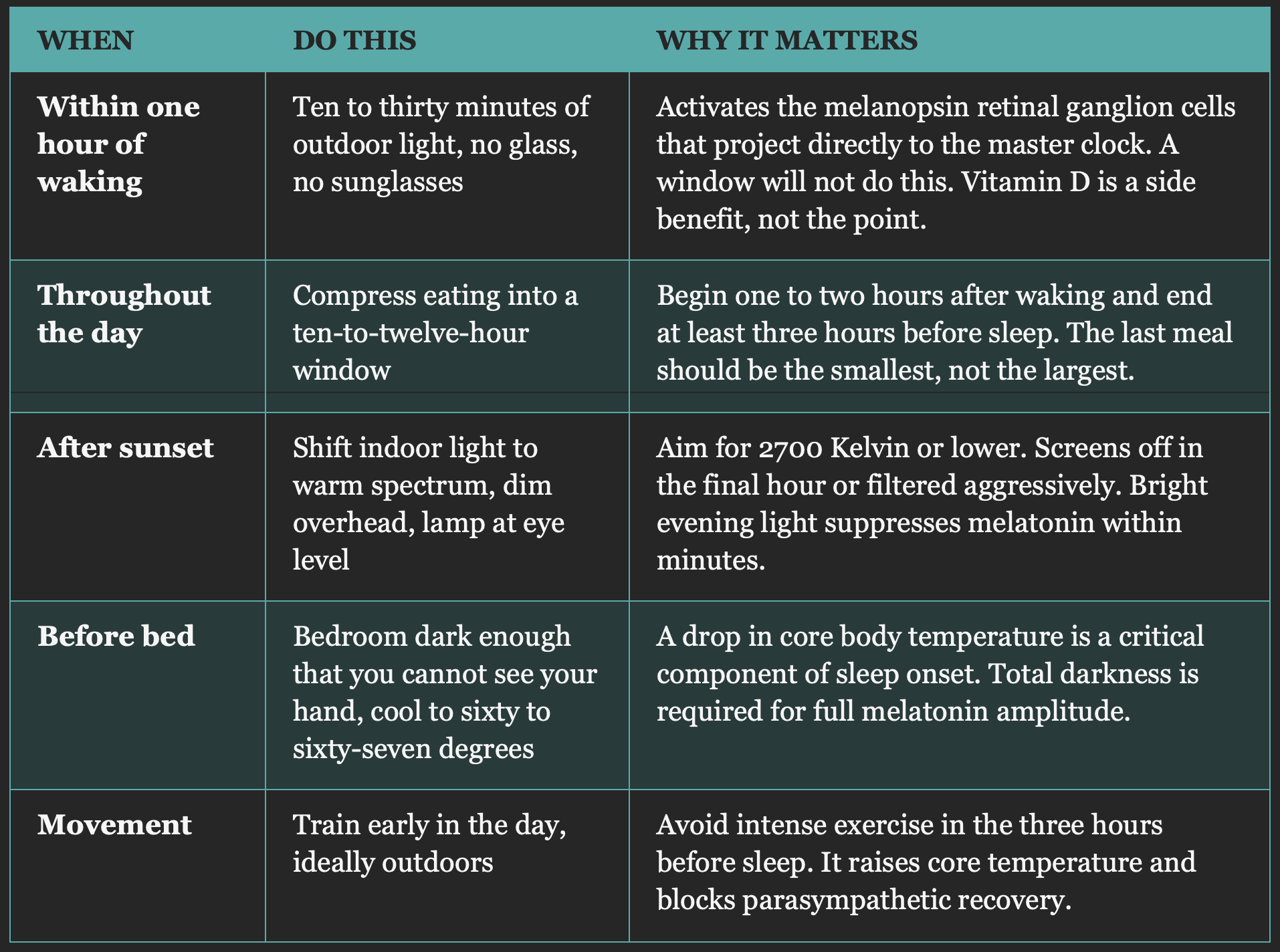
Get bright light in your eyes within an hour of waking. Eat in a ten-to-twelve-hour window that ends three hours before sleep. Dim everything as the sun sets. Make your bedroom dark and cool. Do this for thirty days and notice what changes. The results are usually humbling.
The Deeper Lesson
I keep returning to my client with the prediabetic glucose and the testosterone of a much older man. He did the work. He moved his first meal to nine in the morning and his last to six in the evening. He bought a pair of glasses that filtered blue light after sunset and a small Luxe lamp that simulated sunrise in the winter months. He walked outside for fifteen minutes within an hour of waking, even in January. He turned his thermostat down at night and learned to sleep under more blankets. He set his phone to do not disturb at nine in the evening and kept it in another room.
Within four months, his fasting glucose had returned to normal range. His total testosterone had risen by nearly two hundred points. His resting heart rate dropped seven beats per minute. His LDL particle count corrected. He told me, in the language so many of my clients use when they finally reconnect with their own physiology, that he had gotten himself back. He had not gotten himself back. He had given his body permission to do what it had been trying to do all along. He had returned the conductor to the stage, and the orchestra had remembered the music.
Your biology is not failing you. Your biology is waiting for the signal that tells it what time it is. Give it that signal, and it will do the rest.
There is a temptation in our culture to treat chronobiology as one more optimization lever, another tool to be layered on top of the continuous glucose monitor, the recovery ring, and the twelve supplements. That is not the lesson. The lesson is that we have built a civilization in violation of the temporal laws governing our own cells, and the cost of that violation is being paid in metabolic disease, in hormonal disarray, in premature cellular aging, and in an epidemic of exhaustion that the mental health industry has been unable to name.
The path back is older than technology. It requires nothing more than the willingness to live as if the sun still mattered, as if the darkness were a gift rather than a problem to be solved, as if the rhythms that shaped every ancestor in your lineage for the past two hundred thousand years might still be worth listening to. The conductor has never left the stage. We simply stopped looking for her. She is waiting, as she has always waited, for us to raise our eyes to the light and remember that the first and oldest medicine is the one that arrives with the dawn.
Health is a verb.