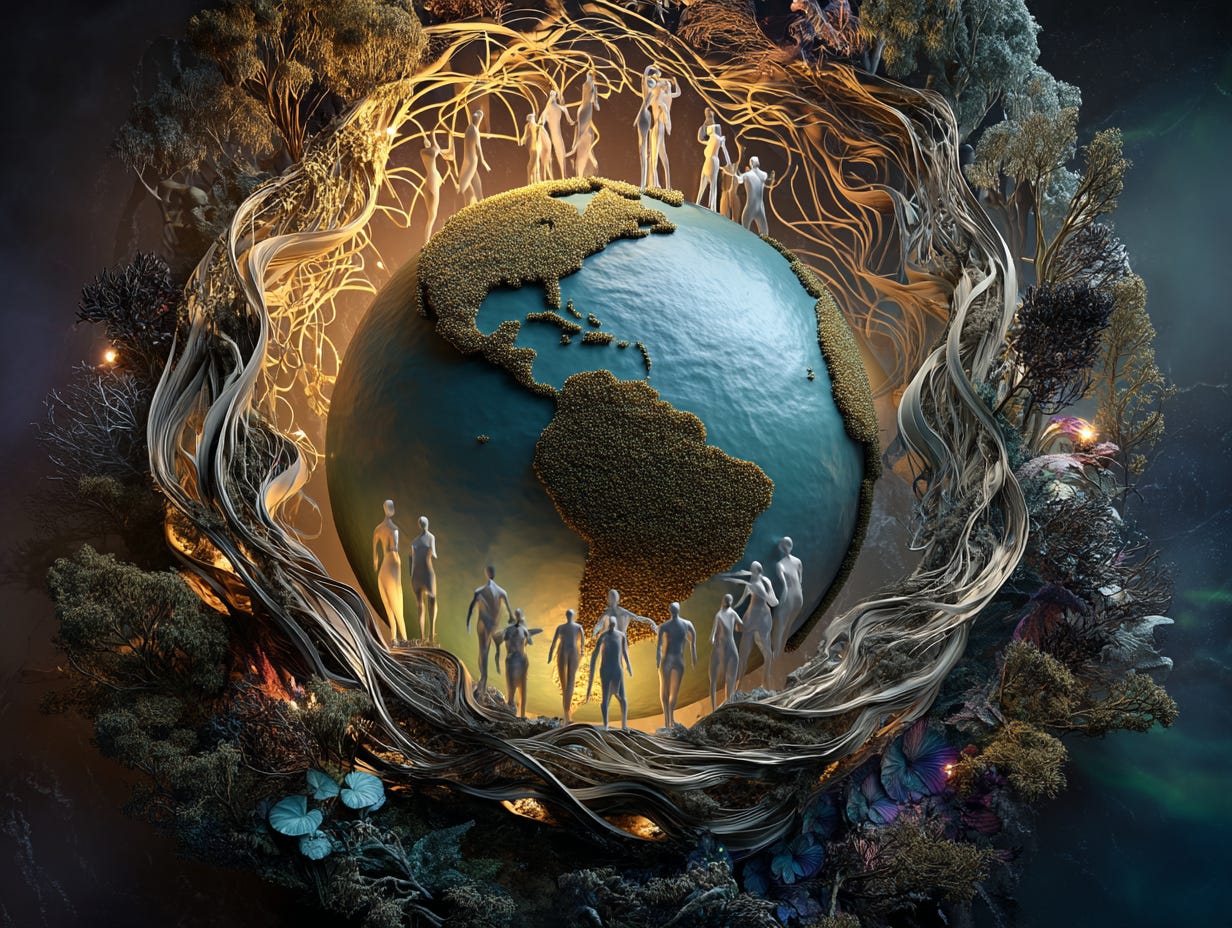

Dawn in the Forest of Signals
Close your eyes for a few gentle breaths and listen for the hum beneath the birdsong, the barely audible thrum of mycelial conversations, the leaf-to-leaf whispers of volatile oils (VOC’s), the subtle shift in the air when sunlight tilts toward storm. In this liminal hush, Nature speaks in a thousand dialects, all at once.
Thanks for reading LoveHealth! Subscribe for free to receive new posts and support my work.
For most of human history we carried those dialects in our bones: the scent of rain shared the ideal time to plant, the resonance of bees mapped the boundaries of blooming meadows, the flavor of a bitter root alerted us to microbial threats. The body was an instrument precisely tuned to our planetary rhythms.
Today the instrument is still here yet the once strong strings have loosened under fluorescent lights and never-ending notification pings. The symphony plays on, ever more insistent, while our frazzled nervous systems struggle to “name that tune”.
The Grammar of Living Systems
Collaborative intelligence in action
Plants as chemical broadcasters. Under herbivore attack, some plants emit jasmonates and green-leaf volatiles that travel on the wind, priming neighboring leaves for defense and summoning parasitic wasps to counter-strike. ¹
This is the plants multipronged approach to defend themselves.
The “Wood-Wide Web.” Mycorrhizal fungi stitch root systems into nutrient-sharing guilds, moving phosphorus, carbon, and electrical potentials between disparate species in milliseconds. ²
This network allows trees to share resources and communicate, providing a support system that enhances resilience and survival.

Edible telegrams. Exosomes inside raw kale, blueberries, or pastured eggs ferry micro-RNAs across species lines and carry tiny regulatory codes capable of damping inflammation and modulating gene expression in our gut epithelium. ³
Each bite of organic, whole food delivers microscopic “mail” that tells your cells to calm inflammation and keep your genes working smoothly.
Here, biology meets poetry; every exchange is both data transfer and devotion.
Four Channels of Planetary Conversation

How We Went Deaf
Sensory Decoupling. Triple-pane glass and HVACs maintain comfort at the price of proprioceptive drift, many no longer feel the barometric drop that signals approaching storms.
Cognitive Bandwidth Theft. The average computer worker toggles between apps 1,200 times a day; the thrum of a cedar waxwing is no match for that dopamine casino.
Cultural Amnesia. Indigenous fire-keepers, whale-songline singers, and seed-story midwives once curated humanity’s ecological lexicon; colonization replaced it with commodity spreadsheets.
Misaligned Incentives. Quarterly profits externalize ecological costs such as pollution, waste, or greenhouse gas emissions, which are borne by society and the environment; a deaf ear is a profitable defense against inconvenient truths.
Food: The Muffled Conversation
Industrial agriculture functions like a noise-canceling headset on the dinner plate. Hybridized seeds grown in depleted soils under petro-chemical guardianship cannot compose the biochemical poetry of a wild nettle in spring.
Domestication Disconnect. Uniform cultivars narrow phytochemical vocabularies; your microbiome receives repetitive, impoverished sentences.
Native plants are those that naturally occur in a specific region, while cultivars are cultivated varieties developed through human intervention.
Geo-Mismatch. Mangoes in a Minnesota January carry tropical epigenetic instructions misaligned with winter-adapted immune rhythms.
This is a fascinating way to consider how food, environment, and epigenetics might interact; suggesting that the timing and origin of our food can potentially have subtle biological impacts.

Processing Silence. Extrusion, pasteurization, and shelf-stable additives can potentially interact with exosomes including MicroRNAs.
Processes like extrusion, pasteurization, and shelf-life additives can distort the exosomal micro-messages in food, depending on the specific technique and ingredients. We still lack full scientific clarity on the biological consequences.
When Nature Raises Her Voice
Ignore the whisper and the body becomes the billboard:
Heat waves impair hippocampal function—memory falters until we redesign urban albedo.
PM2.5 particulate matter crosses the blood–brain barrier, nudging microglia toward neuro-inflammatory phenotypes.
A 20-minute walk in biodiverse greenspace boosts natural killer cell activity by 50 % for up to a week—Nature restating her invitation in immune syntax.⁷
Re-learning the Language
Attunement Protocols: FEEL the Shift
Trace a dawn chorus. Sit outside at sunrise. Track the order each bird joins the song. Over months your nervous system will memorize phenological changes better than any spreadsheet.
Eat the bioregion. Source 30 % of your diet within a 100-mile foodshed this season. Notice shifts in mood, sleep, and stool for subtle biomarkers of regained coherence.
Micro-sabbaticals. Two hours, devices off, in a nearby green patch. Heart-rate variability improves and the ventromedial prefrontal cortex (a region involved in decision-making, reward processing, and emotional regulation) lights up on fMRI.
Regenerative Actions: Answer Back
Garden guilds & pollinator corridors. Every milkweed planted is a syllable of restoration in Monarch dialect.
Citizen-science air monitors. Turn data into neighborhood policy; precision ecology meets grassroots love.
Reciprocity rituals. Whether seed-saving, river cleanup, or gifting a surplus harvest, reciprocity closes the communicative loop

.
The Invitation
Nature’s messages are intensifying not because she is wrathful, but because she is relational. Relationships deepen through feedback. The sirens of flood and flame are, at root, gestures of engagement.
Will we respond as kin or as strangers? What signals has the living world offered you today?
At LoveHealth(v.) we believe the path forward is to braid rigorous science and embodied devotion; heart coherence synced with satellite data, epigenetic assays interpreted in the light of sacred reciprocity.
References
Heil, M. New Phytologist 2018.
Simard, S. (2021). Finding the Mother Tree: Discovering the wisdom of the forest. Knopf. https://suzannesimard.com/finding-the-mother-tree-book/ Check out the YouTube video.
Zhang, L. Cell Host & Microbe 2019.
IPCC AR6 Synthesis Report, 2023.
Basner, M. Lancet 2014.
Potts, R. Science 2014.
Thanks for reading LoveHealth! Subscribe for free to receive new posts and support my work.