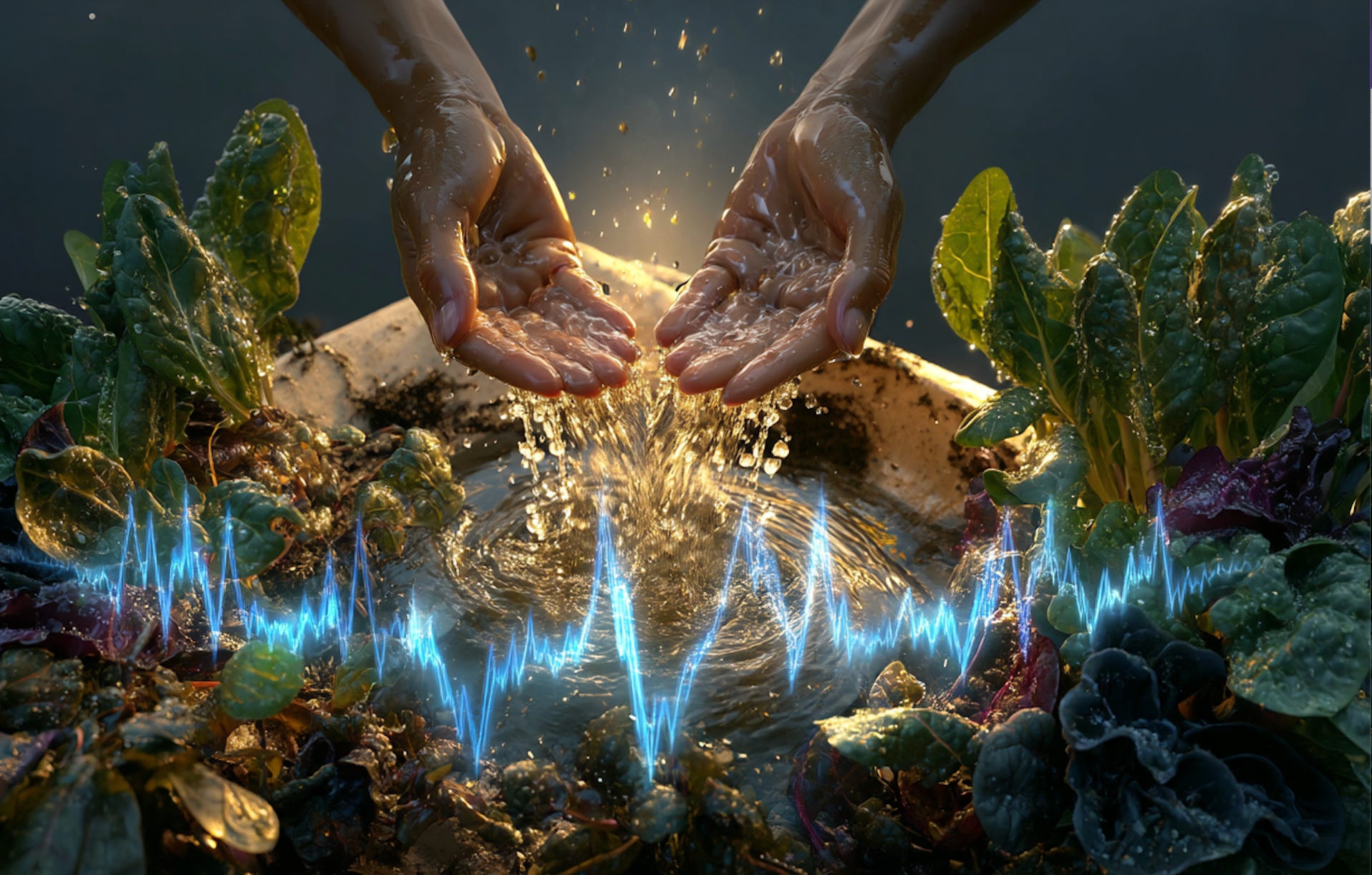

I’m rinsing spinach at the farm‑stand sink just after sunrise. Cold water slips over my fingers, carrying the scent of wet soil and chlorophyll. For a moment the sounds in the environment fade, and I feel the quiet sound of two heartbeats—my own and the planet’s—aligning in my chest.
The Everyday Fracture
America grows more kale than ever, yet half our meals still come from plastic wrappers. Chronic illness drains $4 trillion a year while dead zones spread in the Gulf. We treat the body and biosphere as separate things, but the inflammation in our soil mirrors the inflammation in our blood. This shared dis-ease is the doorway to LoveHealth.
LoveHealth as Living Systems Practice
LoveHealth isn’t a slogan; it’s a systems protocol comprised of compost piles, HRV monitors, and grandmothers who bless the soup.
Love is physiology in motion - vagal tone rises during a genuine hug.
Health is reciprocity; microbes trading metabolites with root hairs and colon walls alike.
When the two verbs synchronize, coherence spreads from mitochondria to watershed.
Interdependence: When Body Maps the Biome

Pause for a deep breath. Some of the oxygen you just inhaled was created by rainforest leaves half a world away; some of the carbon dioxide you exhale will feed the spinach roots at your feet tomorrow morning. The exchange is not poetic, it is molecular barter.
Respiratory Mirror ⇄ Forest Canopy
Cilia in your bronchi sway similarly to the micro‑vibrations that open a stomata on a maple leaf. When urban smog roughens that rhythm, both trees and alveoli stiffen in response.Cardiac Pulse ⇄ River Flow
Healthy watersheds beat in slow oscillations of conductivity and temperature every 90 seconds, matching the average human baroreflex cycle. Pollution flattens the river’s variability and cardiologists note the same dampening in patients with metabolic syndrome.Gut Biome ⇄ Topsoil Web
Much of bacterial genera found in healthy prairie soils have close evolutionary relatives present in the human gut. Glyphosate thins one community, antibiotic overuse the other; diversity falls in lock‑step and with it, resilience.
Immune Diversity ⇄ Greenspace Biodiversity
Children raised on farms, where exposure to a diverse range of environmental microbes is high, consistently show lower rates of asthma and allergic diseases compared to their urban and suburban peers. Farm soils and natural grasslands typically harbor a much greater diversity of soil microbes than suburban lawns, reflecting the impact of land management and environmental complexity on microbial biodiversity.
Endocrine Feedback ⇄ Waterway Hormone Load
Trace concentrations of ethinylestradiol (EE2) from contraceptive use, detected in some U.S. rivers-particularly downstream of wastewater treatment plants-can feminize fish at levels as low as 1–5 ng/L. While oral contraceptives containing EE2 at therapeutic doses can alter sex hormone-binding globulin (SHBG) and thyroid hormone levels in humans, there is not enough evidence that the much lower, environmentally relevant concentrations found in drinking water have measurable effects on these parameters in people.
Mood Chemistry ⇄ Soil Terpenes & Microbe
Inhaling forest phytoncides such as α‑pinene and limonene have been shown to increase natural killer (NK) cell activity and the number of NK cells in humans. Forest bathing also elevates serum serotonin levels, though this effect is not attributed solely to phytoncide inhalation. Contact with the soil bacterium Mycobacterium vaccae enhances stress resilience and modulates immune and neurochemical pathways in mice, with evidence suggesting increased serotonin in the brain and reduced anxiety-like behaviors.
Circadian Clock ⇄ Solar Arc
Exposure to blue light at dawn is a primary signal that entrains the human circadian clock, specifically by activating photoreceptors in the retina that send signals to the suprachiasmatic nucleus (SCN), the brain’s master circadian pacemaker. In plants, blue light promotes the expression of chlorophyll synthesis genes and influences leaf movement (such as leaf angle changes) and other photoreceptor-mediated processes, although the precise mechanisms and timing differ from those in humans.
Cardiac Pulse ⇄ River Flow
Natural, unaltered river systems typically exhibit diverse and dynamic patterns in water quality parameters such as temperature and conductivity, with variability occurring on daily and seasonal timescales due to factors like channel complexity, riparian vegetation, and groundwater exchange. Similarly, individuals with metabolic syndrome show significantly reduced heart rate variability (HRV), reflecting diminished autonomic regulation and baroreflex activity.
Every act that regenerates eco‑systems; rewilding a vacant lot, composting kitchen scraps, planting pollinator strips, feeds back as measurable human benefit. Heal the watershed and you bolster baroreflex tone; enrich topsoil and you diversify your microbiome. Conversely, every plastic wrapper, every unseen pesticide drift, registers somatically as micro‑inflammation or decreased vagal tone.
The metrics we track in a lab panel; HRV, CRP, and blood sugar, echo the vitality indices ecologists log in field journals. Your physiology is a handheld printout of planetary health, constantly updated in real time.
To heal the body is to re‑green the watershed; to mend the soil is to myelinate the brain. One gesture, two beneficiaries, zero separation.
Glimpses of Possibility
Mara, 42, replaced ultraprocessed lunches for soil‑grown salads she helped harvest on Saturdays. Six months: CRP 4.2 → 0.9 mg/L; HRV 32 → 48 ms; mood swings quieted.
A local middle school replaced fluorescent‑lit detention with 10 minutes of forest‑edge breathing. Suspensions dropped; peak‑flow readings in asthmatic students improved within a semester.
A veterans’ gardening co‑op layered fungi‑rich mulch over a city lot. Within a year both soil nitrogen and participants’ WHO wellbeing scores doubled.
Domains of a Thriving Web

Three Invitations
Soil‑to‑Soul Habit
Choose one food each day whose farmer you can name.
Relational Pulse Check
Before bed, tell someone what felt beautiful today. Notice the warmth beneath your sternum; that’s neurotransmitter medicine money can’t buy.
Five‑Minute Ecological Audit
Walk through each room of your home or office once a week. What single toxin (cleaner, plastic, pesticide) can you replace with a living alternative? Track how your body responds.

A Remembered Rhythm
Back at the sink the farmer hands me a bunch of mint, still dripping. “Smell that,” she smiles. The aroma floods my sinuses, and I hear my heart’s rhythm echoing the warble of a meadowlark overhead. Separation between shopper and grower, human and Earth - evaporates for a breath, then two.
This moment is LoveHealth in action: a lived reminder that regenerating soil, relationships, and mitochondria are the same act performed on different stages. The invitation is simple: touch the web each day until you feel it touch you back. When Self and Earth pulse together, prosperity, resilience, and wonder follow; root to leaf, cell to star.
Welcome home to the living web
Thanks for reading LoveHealth! Subscribe for free to receive new posts and support my work.